Product Shape Imitation in Saudi Arabia: When Does an Industrial Design Protect You?
If a Competitor Imitates Your Product’s Appearance Without Using Your Trademark: When Does an Industrial Design Protect You?
If a competitor imitates the shape of your product or its packaging without using your trademark, a trademark lawsuit will not suffice. This article explains when an industrial design serves as an appropriate legal path to protect product appearance in Saudi Arabia, and how a design infringement lawsuit is managed from both statutory and commercial perspectives.
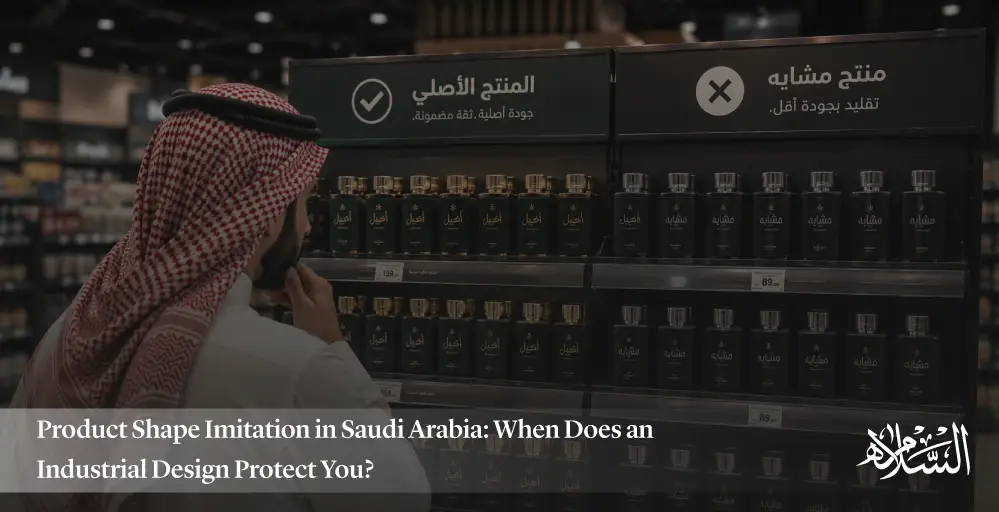
Not every product infringement originates from using the trademark itself. A competitor may omit the name and logo, yet closely approach the packaging appearance, product structure, or external configuration that customers have grown accustomed to. Here, the subject of dispute is not the trademark alone, but the product’s design appearance.
This issue appears clearly in sectors such as food and beverages, perfumes, cosmetics, furniture, housewares, accessories, electronics, and consumer products. A company may spend significantly on design, packaging, photography, and marketing, only for another product to appear in the market that does not bear the same name, but closely approaches the overall appearance enough to capitalize on the original product’s presence in the customer’s mind.
At this juncture, the conventional question is insufficient: Did the competitor use my trademark? The more precise question is: What is the subject matter of protection? Is it the name? The logo? The packaging shape? The product structure? Or the totality of all these elements?
This distinction determines the correct statutory path. A trademark protects the sign that distinguishes the source of goods or services, whereas an industrial design targets the protection of a product’s design appearance or external configuration whenever it satisfies protection conditions. Saudi law establishes independent protection for industrial designs under the Law of Patents, Layout-Designs of Integrated Circuits, Plant Varieties, and Industrial Designs, making product appearance protection a standalone statutory matter rather than a mere technical or marketing aspect.
The First Error: Attempting to Address Every Infringement Through Trademarks
Many files begin with an inaccurate assumption: As long as the counterfeit product resembles our product in the market, the dispute is a trademark dispute. This assumption may hold true if the competitor uses the name, logo, or a similar sign that causes confusion regarding product source, but it falls short if the infringement actually targets the product’s shape or appearance.
A trademark under the GCC Trademarks Law revolves around distinguishing goods or services, whereas an industrial design has a different subject matter; it relates to the appearance, shape, or design configuration. Therefore, a file may be weak if filed or managed as a trademark lawsuit when its true substance is an infringement on a product design.
This is not a theoretical distinction. In one judicial case, a dispute arose concerning a three-dimensional cylindrical shape, and the ruling facts recorded that the administrative authority handled the shape as being closer to an industrial design rather than an inherently distinctive trademark. The significance of this precedent lies in demonstrating the impact of selecting the protective legal framework: A shape may be commercially important, yet not always suitable to serve as a trademark, making an industrial design the more appropriate path.
Therefore, when launching a new product, legal review should not be restricted to searching brand names and classes; it must extend to appearance: Is the packaging distinctive? Does the product shape influence purchase decisions? Can a competitor change the name while maintaining a close impression? If the answer is yes, an industrial design must be integrated into the protection plan from the outset.
When Is a Trademark Insufficient?
A trademark is insufficient when a competitor avoids the mark itself but closely approaches the overall product appearance. In this scenario, establishing a lawsuit based solely on trademark similarity becomes difficult, especially if the name and logo differ. However, infringement may still exist if the protected appearance is registered as an industrial design and the competing product imitates its core elements.
The matter here does not rest on mere subjective impression. It is insufficient for a product owner to state: “Their product looks like ours.” The protected element must be precisely defined: Is it the packaging shape? The design lines? The external structure? The ornamentation? The arrangement of elements? The overall format of the product? These elements are then compared against what exists in the alleged infringing product.
The more defined the subject of protection, the more provable the dispute becomes. Conversely, the more general the claim remains regarding “similarity” without articulating essential points of resemblance, the weaker the file becomes against expected defenses from the opposing party.
An Industrial Design Certificate Is Not an Archived Document
Holding an industrial design certificate can elevate a dispute from a general commercial objection to a claim founded on a registered right. In one judicial precedent, the plaintiff relied on an industrial design certificate issued by the Saudi Authority for Intellectual Property (SAIP), and the dispute revolved around the product protected by that certificate and the extent of infringement upon it. The value of this precedent demonstrates that while a certificate serves as a foundation for a claim, it does not dispense with examining the details of the protected product and the alleged points of infringement.
From this arises the practical rule: Registration is crucial, but it is not the end of the work. Upon the occurrence of infringement, registration must be transformed into an evidentiary file. This file includes the certificate, design images, original product samples, alleged infringing product samples, purchase invoices, photos of market displays or digital platforms, and proof of the product’s launch date and circulation.
How Is the Comparison Between Two Products Managed?
Comparison in industrial design lawsuits must be disciplined; placing two images in a statement of claim and asserting that similarity is obvious is insufficient. What is required is articulating the scope of protection owned by the plaintiff alongside demonstrating the points of infringement upon that protection.
The comparison begins with the industrial design certificate and its attachments: What specifically was protected? Does protection encompass the overall shape? The front of the packaging? A specific configuration? Or an ornamental detail? Next, the alleged infringing product is examined: Did it adopt the exact same core elements? Are the added differences superficial or material? Are the shared aspects common elements within the sector or distinctive features of the protected design?
This type of comparison demands precise language, illustrating the effect of the core elements of the protected design on the product’s overall appearance.
Do Not Assume an Industrial Design Certificate Is Immune to Challenge
A defendant facing an industrial design infringement lawsuit will rarely settle for merely denying similarity. They may argue that the design lacks novelty, that its elements are prior art, that the shape is dictated by product function, that the certificate does not cover the alleged point of similarity, or that the subject product differs in its core elements.
Therefore, the strength of the design must be evaluated prior to filing a lawsuit: Is the certificate active? Is the scope of protection clear? Is the design distinctive over prior art? Are there earlier designs in the market upon which the opponent might rely? Are the similarity elements relied upon aesthetic and design-based, or functional? And do we possess sufficient evidence to demonstrate the impact of infringement on the product and market?
Courts may not stop at the question: Did infringement occur? They often extend to a prior question: Does the protected design satisfy grant conditions? This is a fundamental point in case management, as a plaintiff who fails to review the strength of their right prior to litigation may be surprised when the defense shifts from denying infringement to challenging the underlying protection itself.
When Is an Industrial Design Commercially Critical?
An industrial design becomes critical when appearance constitutes part of the product’s value. In certain products, the name alone is not what attracts the customer, but rather the packaging format, bottle shape, wrap structure, piece design, or the manner in which the product appears on a shelf or in advertising imagery.
In these cases, imitation is not limited to a passing visual resemblance; it can constitute an attack on commercial investment. The company paid the designer, developed the packaging, tested the market, and spent on launch, photography, and marketing, only for a competitor to closely copy the appearance without using the trademark itself.
Here lies the value of an industrial design: It does not protect the name, nor does it replace a trademark, but it can protect what the trademark failed to cover—the design appearance of the product.
The Relationship Between Industrial Designs and Trademarks
There is no absolute preference between a trademark and an industrial design. A strong product may require multiple layers of protection: The name is protected by a trademark, the logo is protected by a trademark, the shape may be protectable as an industrial design, and certain visual elements may trigger other rights depending on their nature and manner of use.
The key is that a company should not select a protection path out of habit. Many companies register trademarks because they are familiar with trademark procedures, but fail to examine design protection. Then, upon the appearance of a similar product, they discover that the infringement did not occur on the name, but on the appearance.
What Should Be Done Before Launching the Product?
Effective protection begins prior to a dispute: What warrants registration as a trademark? What qualifies as an industrial design? Are there common elements in the sector that cannot be monopolized? Are there functional elements upon which protection should not be built? Will the design be introduced to the market prior to completing filing? And are there foreign markets requiring early protection?
This examination is necessary. For products relying on appearance, design can be a commercial asset no less important than the name. A product generating sales due to its shape or packaging should not leave that shape exposed.
What Should Be Done When a Similar Product Appears?
When a similar product appears, one should not jump directly to a cease-and-desist letter or a lawsuit before organizing the file: Does the company hold a registered industrial design? Does it have a relevant trademark? Is there a design, drawing, or visual element protected through another avenue? Following this, a technical and legal comparison between the two products is prepared, and the most suitable path is determined—an industrial design infringement lawsuit, a trademark lawsuit, a compensation claim, or a combined path depending on the facts.
Anticipating opponent defenses prior to filing is essential. They may claim the design is common, the differences are essential, the design lacks novelty, or that what was taken is a functional rather than a design element. Each of these defenses requires an answer before it appears in a defense memorandum.
How Do We Read This Type of File?
Reading a product appearance imitation file does not begin with a desire for litigation, but with the question: What right can be established? If the company holds a clear registered right, the competing product imitates its core elements, and damage is demonstrable, the lawsuit becomes a disciplined file. However, if no certificate exists, the design is common, or similarity lies in functional or familiar elements, alternative paths or the feasibility of the dispute must be assessed prior to entering it.
In managing these files, memorizing statutory texts is insufficient. What matters most is converting commercial appearance into an evidentiary file: a registered right, a scope of protection, a comparison, a commercial impact, and clear claims. This separates an impressionistic complaint from a judicially triable lawsuit.
Conclusion
A competitor may not use your trademark, but they may imitate your product’s appearance. At that point, protection does not belong to whoever registered the name alone, but to whoever properly built multi-angled product protection: a trademark when needed, an industrial design when needed, and an evidentiary file preserving the design, its history, circulation method, and the impact of its imitation on the market.
An industrial design is not a substitute for a trademark, nor is it a marginal administrative procedure; it is an independent tool to protect investment in product appearance whenever that appearance is protectable and impacts commercial value. Published precedents show that this type of right is present in practical judicial disputes—whether by relying on an industrial design certificate, comparing products, disputing the scope of protection, or navigating the overlap between protecting a shape as a trademark versus an industrial design.
In a market where products converge rapidly, an early legal question becomes vital: Are we protecting only the name, or are we also protecting the appearance that sells the product?
(Frequently Asked Questions)
Is trademark protection sufficient to prevent competitors from imitating a product’s shape or packaging? No, it is not sufficient. A trademark protects the sign, name, or logo that identifies the source of goods, whereas an industrial design protects the design appearance and external configuration of the product. If a competitor changes the name but copies the shape, the proper legal line of defense is an infringement lawsuit based on a registered industrial design.
What is the fundamental difference between a trademark and an industrial design under Saudi law? Trademarks fall under the GCC Trademarks Law and aim to identify the establishment/source to prevent consumer confusion. An industrial design falls under the Law of Patents, Layout-Designs of Integrated Circuits, Plant Varieties, and Industrial Designs, aiming to protect two- or three-dimensional aesthetic and design innovation, provided the product’s appearance is not solely dictated by a functional or technical purpose.
Does merely holding an industrial design registration certificate guarantee winning an infringement lawsuit directly? The certificate is the starting point, not the end. Winning a lawsuit requires preparing a comprehensive evidentiary file presenting the court with a comparison of essential differences between the registered design and the counterfeit product, proving market impact, and securing the design’s standing against potential defenses (such as arguments claiming lack of novelty or common usage in the sector).
How is a legal and judicial comparison conducted between the original product and the alleged infringing product? The comparison is conducted by identifying the core and innovative elements protected in the industrial design certificate and its attachments, then evaluating them against the other product to determine whether it adopted those exact distinctive features, while demonstrating that minor variations added by the competitor do not negate the overall imitation of the design.
Can a product be protected by combining a trademark and an industrial design simultaneously? Yes, and this is the optimal approach. Strong products have their names and logos protected through trademark registration, while their innovative shapes and packaging designs are protected through industrial designs—preventing competitors from approaching the product either by name or appearance.