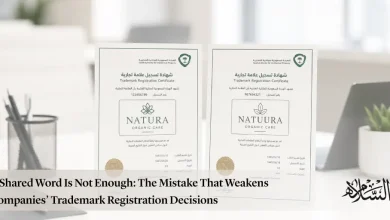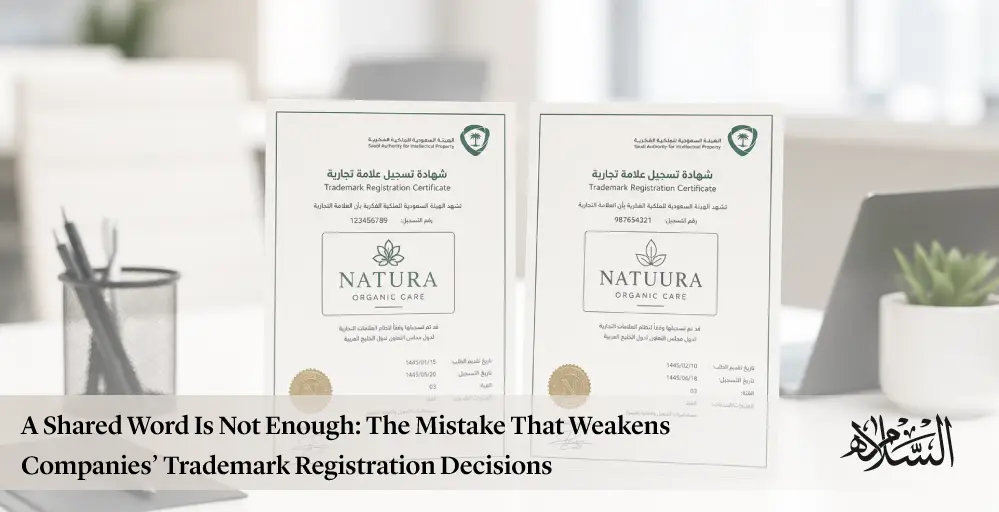
A Shared Word Is Not Enough: The Mistake That Weakens Companies’ Trademark Registration Decisions
Based on our work in trademark registration, oppositions, grievance appeals against refusal decisions, and intellectual property disputes, a recurring error emerges in reading the similarity between marks: reducing a composite mark into a single word, and then basing the entire decision on that word alone.
This reading may seem simple at first, but it can harm the registration applicant just as much as it harms the owner of the prior mark. A company might step back from a defensible trademark simply because a similar word exists in the registry, or it might file a weak opposition because it assumed that a shared word alone is sufficient to prove confusion. In both cases, the issue is not in searching prior trademarks, but in the mischaracterization of what the search revealed.
The decisive question is not: Is there a shared word? But rather: Do the two marks, as a whole, leave a general impression that would lead the average consumer to believe that the goods or services originate from a single source, or that a commercial link, license, or extension exists between the two entities?
A Trademark Is Not Read in Isolation
A trademark does not appear in the market as an abstract term; it appears as a complete entity: name, graphic, color, typography, visual arrangement, phonetic tone, and commercial context. Therefore, extracting a single word from a mark and building a conclusion of similarity upon it may lead to an inaccurate decision.
The commercial judiciary has established that protection applies to the trademark as a whole and to the totality of its elements, rather than to an isolated element. Legal platform precedents have affirmed that considering an individual element without regard to the mark in its entirety is not, in itself, sufficient to rule that similarity exists. This direction aligns with the function of the trademark itself: distinguishing the source in the mind of the consumer, not granting the trademark owner a monopoly over every individual word contained therein.
This rule does not serve the registration applicant alone, nor the owner of the prior mark alone; it protects the precision of the decision. The prior mark deserves protection against genuine proximity, but it does not grant its owner an absolute right to prevent every subsequent composition that includes a word featured within it.
Proper Examination Goes Beyond the Word
The Trademark Examination Manual issued by the Saudi Authority for Intellectual Property (SAIP) clarifies that substantive examination reviews registration applications to verify the absence of similarity or identity with earlier marks, and to ensure statutory grounds for refusal are not met. It also indicates that a mark may consist of words, letters, symbols, drawings, images, pictorial elements, colors, or a combination thereof, provided they are capable of distinguishing goods or services.
This is critical for companies when making a decision to register or object. A registry search may reveal a close mark, but it does not answer the decisive question on its own: Is that proximity legally material? And will this opposition or grievance hold up under full comparison?
Many files do not weaken because the mark is bad, but because it was presented from the wrong angle. Focusing on a shared word may mask a material visual difference, relying solely on a class difference may overlook a clear commercial connection, and asserting fame without demonstrating its impact on the general impression may not be sufficient.
Common Words Do Not Become Absolute Property
In many sectors, certain terms recur because they carry a familiar connotation to the public—suggesting nature, speed, quality, simplicity, luxury, or the commercial field itself. These terms are not always excluded from registration, but they do not grant their owner an absolute monopoly.
The manual establishes that common expressions customary in use for certain products or services are not, in themselves, considered distinctive designations, and no person may claim exclusive ownership over them in abstract. However, it simultaneously establishes that such expressions may become registrable if used in a distinctive manner or format, or if elements are added to render them distinctive.
Here lies the nuance: a common term is not worthless in all cases, nor is it subject to monopoly in all cases. Protection is granted to the distinctive composition, not to the term in abstract.
Ruling No. 4430764683 established a similar principle, addressing a shared element that cannot be monopolized when common, and does not attribute the mark to a specific trader if the other mark appears in a different composition that distinguishes it visually and phonetically.
When Does a Shared Word Become a Risk?
A shared word becomes material when it forms the core element of both marks, when the subsequent mark adopts a close structure, when presentation, color, design, and pronunciation are similar, or when goods or services are linked in a manner that leads the public to associate the two sources.
However, if the word is common or suggestive, and appears within a different composition with distinct graphic, color, or connotation, it may not suffice on its own to refuse registration or sustain an opposition.
In Ruling No. 4530049139, regarding the comparison between a mark containing the word “FARM” and another mark with a different composition, the importance of distinguishing between sharing a term of general meaning and misleading similarity in the overall mark is clearly demonstrated.
This type of judicial application reveals a recurring flaw in the market: attempting to turn a common term into an absolute prohibited zone, even though trademark law does not protect language in itself, but rather protects distinctiveness and the prevention of confusion.
Overall Appearance Can Change the Outcome
The shared word may be apparent, yet visual differences can alter the outcome. Color, design, arrangement of elements, and typography can all create an independent impression.
In certain sectors, consumers recall a mark as a visual image before remembering it as text. This is particularly evident in retail, restaurants, perfumes, apparel, digital applications, and services relying on storefronts, signage, and packaging.
For this reason, verbal comparison alone is often insufficient. The visual element may serve as the decisive differentiator, and the arrangement of words or presence of an additional feature may be enough to move a mark from the sphere of confusion to distinctiveness. Conversely, minor letter variations may not save a subsequent mark if its overall composition evokes the prior mark in the consumer’s mind.
Fame Is Not a Substitute for Material Similarity
Fame strengthens protection, but it does not exempt the mark owner from demonstrating where material similarity lies. A prior mark may be well-known and widely distributed, but that does not mean it owns every word included in its composition.
The value of fame manifests when a subsequent mark approaches a famous mark in a way that recalls it in the consumer’s mind, exploits its reputation, or dilutes its distinctiveness. However, where a common word is shared within a different composition, fame alone may not be sufficient.
This is an important point for companies building oppositions solely on brand strength. Fame should not become a generic argument; it must be tied to a specific question: How will the subsequent mark impact the public’s perception regarding the source of the goods or services?
Class Numbers Do Not Decide the File
A practical mistake is conducting comparisons based solely on the class number. The presence of two marks within the same class does not always mean the services are similar, nor does a difference in classes automatically negate a connection.
Article 9/2 of the GCC Trademark Law provides that goods or services are not considered similar simply because they are listed in the same class, nor are they considered different simply because they are listed in different classes.
This text shifts the framework for analyzing the file. The issue is not a classification number, but a commercial relationship in the mind of the consumer. Are the services connected? Are the sales channels identical? Is the target audience the same? Does the presentation of the mark suggest an extension, license, or relationship between the two entities?
Thus, an opposition may be weak despite identical classes, or strong despite different classes.
Article 3/11 and the True Ground for Refusal
Article 3/11 of the GCC Trademark Law prohibits the registration of marks that are identical or similar to previously filed or registered marks for the same or related goods or services, whenever such registration would generate an impression of association or prejudice the interests of the prior mark owner. The manual lists this ground among the statutory bars verified during substantive examination.
Therefore, the ground for refusal is not abstract verbal similarity; its test is the impact: association or harm. This is the precise point where the outcome of a file changes.
A shared word may exist without creating association, and words may not be identical yet the overall impression establishes a clear link. Thus, a well-crafted memorandum does not rely merely on comparison tables, but builds its standing on the actual impact produced in the mind of the average consumer.
Legal Examination Is More Than Searching the Database
Searching the trademark database is a necessary step, but it is insufficient for making a decision to register, object, or appeal. The search informs you of the existence of a prior mark; legal analysis informs you of that mark’s weight, scope of protection, the extent to which the term can be monopolized, and the risk of confusion in the market.
This is where costly errors occur. A company may refrain from registering a defensible mark because it found a similar word in the registry, or file a weak opposition because it saw a shared word without evaluating the mark as a whole, or build a lengthy appeal on fame when the decisive factor is the common nature of the term or visual impression differences.
In trademark files, not all information is useful. Correct information can weaken a file if misapplied. Fame, for instance, serves as strong support in disputes involving exploitation or association, but can confuse the position if the objective is negating a monopoly over a common term.
A Strong File Is Not Always the Longest
Trademark memorandums are not won by length, nor by the number of images and tables; they are won by the correct perspective.
A company may lose a solid case because it focused on its fame while neglecting the general impression standard. Its opposition may weaken because it sought to monopolize a common term instead of proving that the subsequent mark closely approached its commercial whole. An appeal may fail if based solely on class differences, while the law looks at the relationship of goods or services and their impact on the consumer’s mind.
A file requires precise focus: Is the dispute over the word? The appearance? The fame? The service connection? Bad faith? The common nature of the element? The memorandum is then constructed around that perspective, rather than including every available argument.
Where Does the Outcome Change?
The outcome of a trademark file usually changes at the legal characterization stage, not during document collection. A single document can serve or weaken the applicant depending on how it is deployed, and a shared term may be a core element in one file while serving as an unmonopolizable common term in another.
In files handled by a specialized and licensed IP team, value lies not only in finding numerous precedents, but in selecting the specific precedent that addresses the decisive question. This defines the gap between a memorandum compiling legal texts and a defensible legal position before an examiner, committee, or court.
This professional focus is reflected in Alsalamu Law Firm’s recognition in specialized IP directories such as WTR 1000, alongside holding IP practice licenses from the Saudi Authority for Intellectual Property.
Conclusion
Similarity in a single word is not, in itself, sufficient ground to refuse a trademark registration or sustain an opposition. The standard remains the mark as a whole, the general impression on the average consumer, the strength or commonality of the shared word, the relationship between goods or services, and whether the registration generates an impression of association or prejudices the interests of the prior mark owner.
Protecting a trademark does not mean monopolizing language, but protecting distinctiveness. When an opposition turns into an implicit claim to monopolize a common term, it departs from the law’s objective. Conversely, when an opposition proves material proximity in appearance, wording, impression, or commercial source, protection is rightly placed.
In trademark files, it is not enough for a mark to be visually appealing, actively used, or famous. What matters most is that it is legally evaluated in the manner it will be reviewed during examination, opposition, or litigation. A decision regarding trademark registration, opposition, or appealing a refusal should not be built on a quick registry search or a superficial comparison between two names; it is a decision that impacts the company’s expansion, brand value, and future ability to protect its commercial identity.
(Frequently Asked Questions)
Does the mere existence of a shared word between two trademarks imply a similarity that prevents registration in Saudi Arabia? No, not always. The established principle applied by the Saudi Authority for Intellectual Property (SAIP) and the Commercial Judiciary is that a trademark is evaluated in its overall context and general impression (including colors, fonts, graphics, and commercial context), rather than by isolating a single word—especially if that word is common or suggestive.
What is the legal principle regarding the protection of common words or terms used in commercial custom? The law does not grant anyone the right to monopolize language or common terms simply because they are included in a mark. However, if a common word is added within a distinctive composition or design that prevents consumer confusion, protection applies strictly to that specific composition, without preventing others from using the word in entirely different structures.
Does a difference in the registration class number prevent refusal or eliminate trademark similarity? No. Pursuant to Article 9/2 of the GCC Trademark Law, goods or services are not considered different simply because they fall under different classification categories, nor are they considered similar merely because they exist within the same class. The determining factor remains the actual commercial relationship and the genuine likelihood of public confusion.
When does a shared word become a primary ground for trademark refusal or sustaining an opposition? A shared word becomes legally material in grounds for refusal when it serves as the core and dominant element in both marks, and where the overall composition, presentation, and nature of the products or services inevitably lead the average consumer to assume an association or commercial license exists between the two entities (generating an impression of association under Article 3/11).
Does the fame of a prior trademark give its owner an absolute right to prevent the use of any word contained within it? Fame strengthens the scope of legal protection, but it does not exempt the owner from proving material similarity. Fame does not convert a general term into exclusive property; rather, it requires demonstrating that the use of the subsequent mark will exploit the reputation of the famous mark or dilute its commercial distinctiveness in the consumer’s mind.