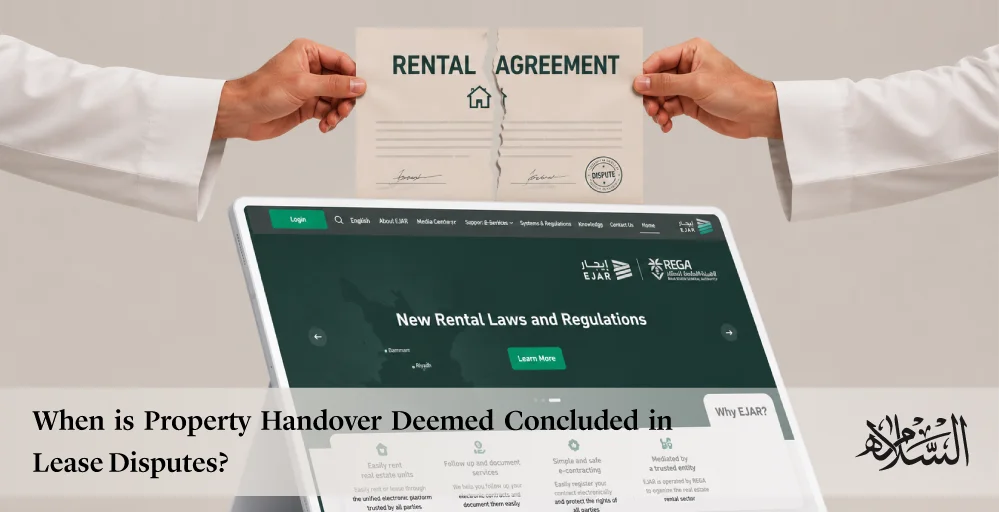
When is Property Handover Deemed Concluded in Lease Disputes?
In lease disputes, the critical point of risk does not always reside in the execution of the contract, but rather at the moment of exit. The vast majority of complex disputes referred to our Firm do not originate upon the inception of the relationship, but rather at its termination:
- Has the lease expired?
- Has the property been vacated?
- Does the tenant still maintain possession?
- Is the mere tendering of the keys sufficient?
- Can the lessor refuse to take possession and subsequently claim the accrual of ongoing rent?
These questions are by no means theoretical. They directly impact landlords, commercial tenants, property managers, real estate brokers, real estate funds, and corporations operating branches or operational centers. In an environment where lease contracts are electronically authenticated, a standalone understanding of statutory provisions is insufficient; rather, it is imperative to comprehend the interplay between the contract, the “Ejar” platform, correspondence, handover protocols, and the condition of the property upon exit.
Al-Salama Law Firm has previously dedicated a practical handbook to these matters entitled “333 Questions and Answers on the Electronic Lease Contract in Saudi Arabia,” prompted by the sheer volume of complications arising during the digital operation of contracts, rather than their mere reading. An electronic contract is no longer a static instrument; it has become an operational pathway governed by procedures, statuses, approvals, requests, invoices, and statutory effects that must be handled with utmost precision.
The Legal Nature of Property Handover: Real Estate is Not Handed Over Like Chattel
The primary error in many lease disputes lies in treating real property as if it were personal property (chattel). Equipment, vehicles, or commodities are physically transferred from hand to hand; conversely, possession of real property is established via Takhliya (vacation/relinquishment of possession), removal of the possessing hand, and enabling the right-holder to enter and enjoy the property.
Accordingly, the Court of Appeal, in its Judgment No. 1089 of 1441 AH, established a direct precedent:
“It is jurisprudentially settled that the handover of real property and the like is effected via Takhliya (relinquishment of possession).”
This statement is pivotal because it shifts the focus of the argument from a formalistic inquiry—Was the handover protocol executed?—to the substantive question: Was possession relinquished to enable the landlord to take over the property? And does there remain any impediment on the tenant’s part preventing such possession?
This legal meaning does not negate the significance of protocols or electronic templates, but it positions them in their proper context. A handover protocol serves as evidence and regulation, and it may constitute a contractual condition if explicitly stipulated in the lease; however, it must not be transformed into a means to frustrate the legal effect of Takhliya if the party requested to take possession is the one who abstained or procrastinated.
Relinquishment of Possession is the Natural Consequence of Lease Expiration
Upon the expiration of a lease, the tenant retains no right of use or enjoyment. The natural consequence thereof is the removal of their hand from the premises and its vacation. The Board of Grievances, in its Judgment No. 1348 of 1442 AH, ruled that:
“The removal of the tenant’s hand from the leased premises and its vacation is an effect of the expiration of the lease contract.”
The Panel decreed that once the contract expires, the tenant is statutorily obligated to remove their hand from the premises and vacate it. This legislative baseline mandates that we decisively differentiate between two scenarios to avoid the commingling of liability:
- The First Scenario: Where the tenant remains in occupation of the property, retains their belongings therein, or prevents the lessor from taking possession. Here, the lessor’s right to claim subsequent rent or compensation arises in accordance with the law and the facts.
- The Second Scenario: Where the tenant fully removes their hand, clears the premises of all encumbrances, and enables the lessor to take possession, yet the lessor delays or refuses to take possession, conditioning it upon extraneous requirements. In this scenario, it is legally impermissible to automatically presume the continuity of rent merely due to the absence of a signed handover protocol.
The executive standard here is: Which party obstructed the handover? If the obstruction was caused by the tenant, the risks fall upon them; if it was caused by the lessor, their refusal or procrastination cannot be converted into an open-ended debt imposed upon the tenant without a statutory basis.
The “Ejar” Platform Regulates Procedure But Does Not Negate Facts
The “Ejar” platform has become an integral component of the legal and operational infrastructure of lease contracts in Saudi Arabia. The Ejar Services Manual dictates that the “Mutual Termination Service” enables either the lessor or the tenant to submit a termination request. The counterparty can then log into the network, review the request, and subsequently approve or reject it. The manual further provides that the status of the contract will display as “Terminated” upon approval, and remains “Active” upon rejection of the termination.
These details are critical because they dictate that silence or non-responsiveness is not always a neutral stance. If a termination request is transmitted to the counterparty, and they possess the capability to accept or reject it while stating the grounds for rejection, yet they permit the grace period to lapse or fail to exercise the option of rejection in a timely manner, they cannot subsequently portray the matter as though the requesting party failed to pursue the statutory path.
Conversely, the Ejar platform does not imply that every consequence of the relationship is resolved exclusively online. Issues regarding the condition of the premises, damages, utilities, waste, financial dues, and settlements may remain the subject of an independent dispute. However, these issues must not be commingled with the core event of vacation if Takhliya has been effected and possession of the property has been relinquished.
Do Not Commingle Vacation with the Physical Condition of the Premises
One of the most prevalent pragmatic errors in lease contracts is the commingling of two distinct matters: the handover of the premises on one hand, and the condition of the premises upon handover on the other. A lessor may well possess the right to demand that the tenant repair damages, remove alterations, reinstate certain conditions to their original state, or pay compensation for proven damages; however, the existence of such claims does not legally negate the occurrence of vacation.
- Vacation and Termination: Answer a possessory question: Has the tenant’s hand been removed, and has the lessor been enabled to take possession of the property?
- Condition of the Premises: Answers a compensatory question: Was the property handed over in accordance with the stipulated specifications? And has a financial right accrued to the lessor as a result thereof?
Commingling these two pathways yields an inequitable outcome: the lessor refuses to take possession due to remarks regarding the premises, and subsequently demands ongoing rent on the pretext that the lease remains force. The legally and executionally correct approach is to substantiate the vacation once Takhliya is fulfilled, while preserving the lessor’s rights to pursue independent claims for damages, alterations, or repairs once verified.
The Scope of the Tenant’s Obligation: The Default Rule is the Relinquishment of Possession Unless Stipulated Otherwise
Among the notable judgments in this domain is Commercial Judgment No. 4430637211 of 1444 AH, which ruled:
“The default rule governing the tenant upon lease expiration is merely to remove their hand from the leased premises, and they are neither obligated to redeliver it nor bear the costs of such redelivery unless the parties have contractually stipulated otherwise.”
The judgment cited Kashshaf Al-Qina’, affirming that if the lease term expires, the tenant removes their hand from the leased premises and is not liable for redelivery or its costs, while confirming that a specific contractual condition obligating the tenant to redeliver shall be enforceable.
This rule does not grant the tenant a license for chaos, nor does it exonerate them from contractual conditions; rather, it prevents the imposition of obligations not contemplated in the contract or holding the tenant liable for consequences caused by the counterparty. If the lessor desires the handover to be conditioned upon a specific protocol, a defined inspection, a particular reinstatement of condition, delivery to a property management firm, or the removal of fixtures, the contract must explicitly provide for such terms.
Hence, there emerges an urgent necessity for meticulous care in drafting commercial and investment lease contracts. The real estate asset here is not a simple residential apartment; it may be a corporate branch, a restaurant, a warehouse, or a massive operational center containing improvements, decorations, and complex technical fixtures. In such contracts, drafting the “Exit and Vacation Mechanism” clause becomes far more critical than drafting the inception of the lease relationship.
When Does the Claim for Subsequent Rent Devolve into an Unlawful Dispute?
Rent, by definition, is consideration for the enjoyment of a benefit (usufruct). If the tenant continues to enjoy the property, retains hold of it, or prevents the lessor from entering it, a claim for rent for the subsequent period is comprehensible. However, if the tenant vacates the property, removes their hand therefrom, and enables the lessor to take possession, the continuity of claiming rent requires a different legal basis.
It is insufficient to argue that the contract remains visible as active on the platform, that the handover protocol was not signed, or that there are defects in the premises. The underlying cause must be scrutinized: Did the usufruct remain under the control of the tenant? Or did the delay arise from the lessor’s non-acceptance, procrastination, or refusal to take possession? If the fault lies with the lessor, the claim for subsequent rent becomes subject to serious legal scrutiny.
Here, the significance of Article 3 of the Law of Procedure before Sharia Courts becomes manifest. A lawsuit is not admissible merely by formulating a plea, but requires the existence of a current, legitimate interest. If a plea for eviction is brought against a property already vacated, or a plea for rescission is brought against a contract previously terminated, the lawsuit may lose its subject matter or interest, particularly if it is utilized to generate an indirect financial effect rather than articulating the true claim in its proper manner.
Protocols to Follow Upon Vacating the Property
Managing the moment of exit from a leased property must be a legally documented, calculated process. Our Firm recommends the following procedures to ensure statutory safety:
| For the Tenant (Upon Vacation) | For the Landlord (Upon Termination) |
| • Serving notice to the lessor of the intent to terminate within the contractually stipulated timelines. | • Decisively managing termination requests via the “Ejar” platform (either by acceptance or reasoned rejection). |
| • Pursuing the electronic pathway to request termination via the Ejar platform. | • Immediately documenting the condition of the premises via an engineering report or a conditional assessment protocol if damages exist. |
| • Substantiating the vacation of the premises and the removal of possession via all methods of proof (correspondence, photographs, witness testimony). | • Refraining from commingling the right to claim compensation for damages with the right to possess and take over the property. |
| • Formally tendering the keys in a legally written and documented manner. | • Initiating an independent lawsuit for compensation without withholding the handover of the property, thereby avoiding the forfeiture of ongoing rent claims. |
Furthermore, both parties must differentiate between three distinct dates: the date of contract expiration or rescission, the date of premises vacation and removal of possession, and the date of executing the handover protocol. In practical reality, these dates may vary, and each variance can shift the accrual of rent, liability, or the burden of proof.
Contract Drafting is the First Line of Defense
Professional contracts are those that do not leave closing moments hanging to chance. A meticulously drafted lease contract must precisely delineate the parameters of vacation:
- When is the property deemed vacated and entitled to the cessation of rent accrual?
- What is the approved legal mechanism for handing over the keys?
- What is the legal effect if one of the parties abstains or fails to attend the scheduled session for executing the handover protocol?
- How are technical remarks on the condition of the premises preserved and substantiated without affecting the fact of vacation?
- Delineating the legal effect of electronic notices, text messages, and requests submitted via the Ejar platform, along with the specified response timelines.
These questions are no longer mere administrative details; they have become foundational to lease risk management. Mirroring the mechanisms of the Ejar Services Manual (from submitting requests and shifting contract statuses to “Terminated” or “Active”) within the core text of the contract safeguards corporations and investors from entering into long-term financial disputes.
Strategic Summary
In lease disputes, it is insufficient to ask: Was the handover protocol executed? The more accurate inquiry is: Was Takhliya (vacation) fulfilled? Has the tenant’s hand been removed? Has the lessor been enabled to take possession? And which party obstructed the handover?
Takhliya is not a semantic matter; it is a legal and executional standard that determines when the tenant’s possession ceases, when the accrual of rent halts, and when an eviction plea becomes redundant. In the modern real estate market, where electronic contracts intersect with correspondence, digital platforms, and protocols, managing the moment of exit is far more critical than the moment of execution.
Whosoever regulates the mechanism of Takhliya in the contract, documents the steps of termination, and segregates vacation from the physical condition of the premises, effectively minimizes the scope of subsequent litigation. Conversely, whosoever leaves this stage ambiguous may find themselves facing a lawsuit that revolves not just around property, but around a far more perilous question: Who manufactured the dispute after it could have been conclusively resolved?
Frequently Asked Questions (FAQs)
Q1: What is the settled rule regarding the handover of real property?
A: It is jurisprudentially settled that the handover of real property and the like is effected via Takhliya (relinquishment of possession), which signifies evacuating the premises and removing the possessing hand therefrom.
Q2: How did the Ejar platform resolve the complication of handing over the leased premises?
A: The Ejar Services Manual dictates that the Mutual Termination Service enables either the lessor or the tenant to submit a termination request. The counterparty can then access the network, review the request, and subsequently approve or reject it. The manual provides that the status of the contract will display as “Terminated” upon approval, and remains “Active” upon rejection of the termination.
Q3: How is a lease contract properly drafted?
A: A well-drafted contract does not leave the moment of exit hanging. It must precisely define when the property is deemed vacated, how keys are delivered, who executes the handover protocol, the effect of a party’s failure to attend or execute the protocol, and how remarks regarding the condition of the premises are preserved—and whether such remarks bar the fulfillment of vacation or trigger an independent claim.
Furthermore, the contract must regulate electronic termination via the Ejar platform: Who initiates the request? What is the response timeline? What is the effect of non-responsiveness? How is the financial settlement conducted? And are electronic notices, text messages, and correspondence between the parties legally admissible? These questions have become core to lease risk management.