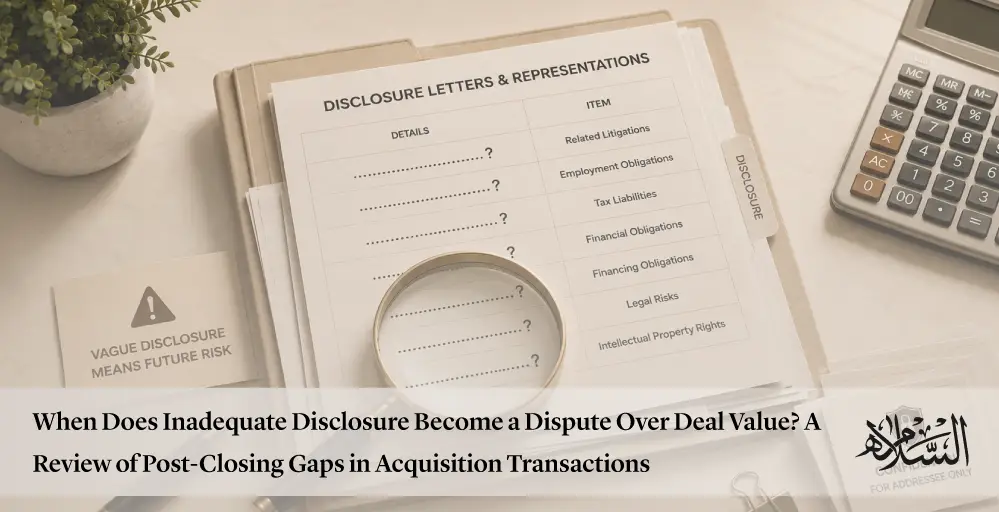
When Does Inadequate Disclosure Become a Dispute Over Deal Value?
In acquisitions and business sale transactions, it is not enough for documents to have been made available or for the buyer to have signed an acknowledgement confirming that due diligence was conducted. Failure to disclose material information may, after closing, develop into a dispute concerning the purchase price, the applicable warranties, and which party should bear the resulting difference in value.
In one acquisition dispute, the post-closing disagreement did not concern an obvious asset or defective equipment. Rather, it concerned a bank guarantee and credit facilities that were alleged not to have been disclosed at the time of the acquisition.
Although these matters may appear financial in nature, they directly affect the value of the transaction. A bank guarantee, credit facilities, and banking liabilities may alter the valuation of the company and raise a fundamental question after closing:
Did the buyer pay for the company as it was presented, or for a company carrying a risk that had not been reflected in the price?
In one published commercial case, a party argued that a bank guarantee had not been released and that credit facilities recorded against the company had not been disclosed at the time of the acquisition.
This is where disclosure problems in business sales and acquisitions begin—not with the number of documents delivered, but with whether information capable of affecting the price, the decision to proceed, or the scope of the seller’s warranties was disclosed clearly.
Material Information Is More Important Than the Volume of Documents
The existence of a document does not necessarily mean that the underlying risk was adequately disclosed.
Financial statements may have been provided, while the effect of a banking liability on cash flow remains unclear.
Customer agreements may have been made available, without drawing the buyer’s attention to the fact that certain agreements may terminate or be affected by a change in ownership.
Licensing documents may be present, while failing to reveal that a licence is temporary, conditional, or subject to an existing violation.
Employee records may also be provided without showing the implications of residency permits, employee transfers, potential claims, or overdue employment liabilities.
These are not merely administrative matters. In a business sale, they are factors that directly affect the value of the asset or business being acquired.
Accordingly, when a dispute arises, it is not enough to say:
“The documents were available.”
The questions will be more precise:
Where was the material information disclosed?
Was it clearly presented?
Was it reflected in the purchase price?
Did the buyer knowingly accept the risk, or did the matter remain covered by the seller’s warranties?
General Disclosure Does Not Resolve the Risk
A statement such as “the buyer has reviewed all documents” may appear sufficient at closing, but it does not, by itself, answer the questions that may arise later:
What information was actually disclosed?
Where was it disclosed?
Was it material to the price, the warranties, or the buyer’s decision to proceed?
Disclosure that provides genuine protection is not based on overwhelming the buyer with documents. It depends on identifying material exceptions, including:
- Banking liabilities;
- Existing claims;
- Incomplete licences;
- Assets not fully owned by the target;
- Agreements capable of being terminated;
- Employment-related liabilities;
- Zakat or tax claims; and
- Any other matter that may affect the value or operational viability of the business.
The issue does not concern the seller alone.
A buyer who asserts after closing that it was unaware of a particular matter may be questioned regarding the scope of its due diligence, the documents made available to it, the reservations it raised, and the warranties it requested before signing.
Due Diligence May Protect the Seller and Weaken the Buyer’s Position
Due diligence is not merely a procedural stage that ends when the transaction closes.
In a subsequent dispute, the due diligence process may become a defence for the seller or an evidential burden for the buyer.
Where it is established that the buyer examined the company’s records, reviewed its financial position, and had access to the material documents, the seller may argue that the relevant risk was known or reasonably discoverable.
Conversely, a general statement that “the buyer conducted due diligence” will not necessarily be sufficient where the risk was not apparent, the seller gave a specific warranty, or the material information was not clearly presented.
For this reason, professional legal commentary on the Saudi Civil Transactions Law in the context of corporate transactions frequently links due diligence, disclosure letters, warranties, and the valuation of the target company. These are interrelated mechanisms for allocating risk after closing.
The distinction is important:
Asset due diligence asks: What does the company own?
Transaction due diligence asks: What may reduce the value of that ownership after closing?
Warranties Are the Mechanism Through Which Risk Is Allocated
In business sale and acquisition agreements, warranties should not be treated as standard wording placed at the end of the contract.
Warranties are the provisions through which the parties determine who will bear a particular risk if information or liabilities emerge after closing.
Does the seller warrant that the company has no undisclosed liabilities?
Does the seller warrant the accuracy of the financial statements?
Does the seller warrant that all licences and permits are valid and compliant?
Does the seller warrant ownership of the assets used in the business?
Does the seller warrant that there are no material employment, zakat, or tax claims?
Are matters identified in the disclosure letter excluded from those warranties?
These questions determine the legal position of each party if a dispute arises.
Where a bank guarantee, credit facility, claim, or liability emerges after closing, the dispute will not be limited to whether the matter existed. The parties will also examine its treatment under the agreement:
Was it covered by a warranty?
Was it expressly excluded?
Did the seller disclose it?
Did the buyer accept it as part of the agreed pricing?
This is the difference between an agreement that merely completes the transaction and an agreement that properly allocates its risks.
Proper Disclosure Also Protects the Seller
Some sellers view disclosure as weakening their negotiating position. This is a short-sighted approach.
Proper disclosure may be one of the strongest protections available to the seller because it identifies what the buyer knew, what was reflected in the price, and what was excluded from the scope of the seller’s warranties.
Where the buyer later attempts to reopen the purchase price on the basis of a defect, omission, or liability, the relevant question becomes:
Was this risk not specifically disclosed?
Was it not taken into account when the transaction was priced?
What weakens the seller’s position is not clear disclosure, but broad and general disclosure. General wording allows each party to interpret the disclosure differently after a dispute has arisen.
A matter that appeared minor at signing may then become the central issue in post-closing litigation.
The Civil Transactions Law Is Not a Substitute for Proper Transaction Drafting
The Saudi Civil Transactions Law provides that a seller is responsible for a defect that reduces the value or utility of the subject matter of the sale.
It also provides that, upon discovering a defect, the buyer may seek rescission or retain the subject matter and claim the difference in price.
The Law further addresses the effect of the buyer’s knowledge of the defect, the buyer’s ability to discover it through customary inspection, and the specific period applicable to claims based on a warranty against defects.
These rules are important, but they are not a substitute for properly drafting the transaction documents.
In an acquisition, the dispute may not concern a simple defect in the subject matter of a sale. It may concern:
- Financial information;
- An undisclosed liability;
- A licence;
- Employees;
- A customer agreement;
- An operational asset;
- A debt; or
- A claim materially affecting value.
In such cases, the agreement becomes the primary arena for determining the outcome through its provisions on:
- Disclosure;
- Warranties;
- Exceptions;
- Limitations of liability;
- Claim periods; and
- Purchase price adjustment mechanisms.
A party that relies solely on general statutory provisions leaves substantial room for dispute.
A party that properly regulates disclosure and warranties before closing narrows the scope of disagreement or ensures that the relevant risk is both known and appropriately allocated.
How Should Disclosure Be Reviewed in a Transaction?
When reviewing business sale and asset purchase agreements, we do not treat disclosure as an annex separate from the main agreement.
We review it together with the purchase price, warranties, exceptions, and the scope of due diligence.
The question is not:
Were the documents delivered?
The question is:
Was the information capable of affecting the purchase decision, the price, or the scope of the seller’s liability clearly disclosed?
The risk does not arise merely from whether a disclosure letter exists. It arises from the quality of that disclosure.
Did it identify the liability?
Did it link the matter to a particular document?
Did it explain its effect?
Did it exclude the matter from a specific warranty?
Did the buyer expressly accept the exception, or was the price adjusted to reflect it?
This approach is not intended to make the agreement unnecessarily lengthy. Its purpose is to prevent incomplete information from becoming, after closing, a claim for diminution in value, a warranty claim, or a dispute concerning the proper interpretation of the transaction.
Conclusion
Inadequate disclosure does not always become apparent at signing. It often emerges only after the information comes to light, the purchase price has been paid, and the transaction has closed.
At that stage, the dispute is no longer merely about a missing document. It becomes a dispute over the value of the transaction:
Did the purchase price reflect the true position?
Who should bear the difference if it did not?
Weak disclosure does not eliminate risk; it postpones it.
A party that fails to connect disclosure with valuation before closing may leave the purchase price open to challenge after a dispute arises.
Frequently Asked Questions
Does Making Documents Available in a Data Room Protect the Seller Against Claims Concerning Undisclosed Liabilities?
No. Merely making documents available or overwhelming the buyer with large volumes of material is not sufficient to exclude liability.
Where a liability—such as an outstanding bank guarantee or credit facility—is material, affects the purchase price, and was not expressly and clearly disclosed in the approved disclosure letter, the buyer may seek recourse against the seller for the difference in price or compensation for the resulting diminution in value.
How Does a Change-of-Control Clause in Customer Agreements Affect the Value of an Acquisition After Closing?
A change-of-control clause may constitute a significant hidden risk.
Where a strategic customer agreement grants the customer the right to terminate upon a change in ownership of the target company, and the seller fails to disclose that provision clearly, the loss of the customer after closing may entitle the buyer to bring a claim for a reduction in the purchase price.
This is because the profitability assumptions upon which the transaction price was based may have materially collapsed.
What Is the Distinction Between a Defect Covered by Statutory Warranty and a Financial Liability in a Business Sale?
The Saudi Civil Transactions Law provides protection in respect of latent defects that reduce value.
In acquisition transactions, however, defects and liabilities are usually addressed in greater detail through the warranties and representations schedule.
The agreement therefore becomes the primary basis for determining liability.
Any liability that was not expressly disclosed may be treated as a breach of contractual warranty giving rise to direct compensation, without necessarily requiring the buyer to establish all the traditional elements of a latent-defect claim.
When Does Clear Disclosure Protect the Seller and Prevent the Purchase Price from Being Reopened?
Disclosure becomes a protective mechanism for the seller when it is specific, properly identified by number and date, and supported by a relevant document, rather than being stated in broad and general terms.
Such disclosure allows the seller to establish through documentary evidence that the buyer was aware of the particular risk—such as pending tax proceedings or a temporary licence—expressly accepted it, and factored it into the pricing of the transaction.
This may prevent the buyer from subsequently reopening the transaction on the basis of contractual regret.
How Should a Financial Limitation-of-Liability Clause Be Structured to Protect the Parties?
Our firm structures limitation-of-liability provisions by setting a maximum financial cap on the claims and compensation that the buyer may pursue against the seller after closing.
For example, the agreement may provide that aggregate compensation shall not exceed 20% of the total purchase price.
The clause may also specify a defined claims period, after which the buyer may no longer bring claims under the relevant contractual provisions.
This helps preserve transaction certainty and prevents the seller from remaining indefinitely exposed to post-closing litigation.