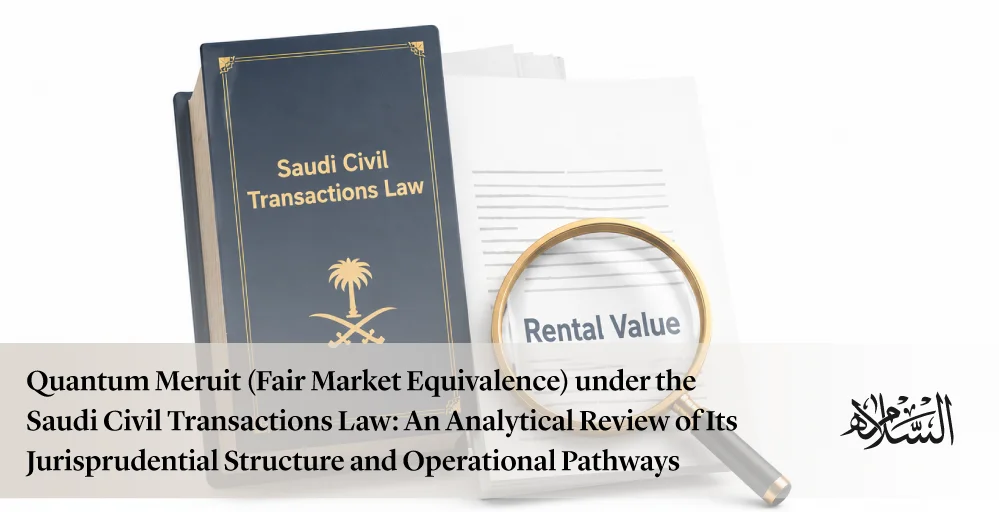
Quantum Meruit under the Saudi Civil Transactions Law
Among the doctrines meticulously overhauled and codified within a structured statutory framework by the new Civil Transactions Law, the concept of Quantum Meruit / Fair Market Value stands out, appearing in approximately twenty-nine separate provisions. This heavy statutory footprint underscores the legislature’s intent to anchor “fair market equivalence” as a universal standard of contractual equity. It stabilizes financial obligations in the absence of an express agreement, or upon the occurrence of harm, unjust enrichment, or unauthorized usufruct.
An analysis of how “market equivalence” is woven into the Law reveals a singular, cohesive doctrine with multifaceted applications. It spans across leases, construction covenants (Muqawalah), agencies, loans, usufructuary rights, and compensatory damages. It even extends to the financial dynamics of eminent domain, agricultural partnerships, and rights in rem. This structural versatility mirrors advanced comparative global legislations and serves as a natural extension of established judicial and Sharia principles, which have long championed market equivalence as the ultimate arbiter of equity.
First: Market Equivalence as a Core Legal Philosophy
The Civil Transactions Law establishes the doctrinal foundation of market equivalence in Article (21), drawing a clear distinction between fungible (Mithli) and non-fungible (Qaymi) things. Fungibles are defined as items whose units are so physically similar that they can substitute for one another without any customary or material difference. While seemingly rudimentary, this definition carries immense weight wherever the terms Quantum Meruit (fair market rent/wage), fair market value, or fair market price are invoked throughout the statute.
Crucially, the Law does not treat market equivalence as an abstract valuation metric. Instead, it embeds it as the primary axis of measurement for performance, compensation, restitution, usufruct, and the unwinding of financial ties when a primary contractual relationship can no longer be sustained.
This pervasive dissemination of the doctrine throughout the new code demonstrates the Saudi legislature’s strategic shift toward standardizing equity in financial obligations. It measures transactions against actual, real-world dealings between similarly situated peers within the same economic ecosystem—a trend visibly executed across chapters ranging from leases to construction and agency contracts.
Second: The Sectoral Distribution of the Market Equivalence Doctrine
A comprehensive reading of the Civil Transactions Law reveals that Quantum Meruit is not merely an isolated clause within the law of leaseholds. Rather, it is a pivotal default rule that transitions across sectors with remarkable agility. Its application can be categorized into four primary dimensions:
1. Leases and Usufruct: Remedying Gaps and Forced Extensions
In Articles (415) et seq., the doctrine of fair market rent is triggered whenever a right of use or occupancy extends beyond an agreed term due to omission or compelling necessity. If a lease expires and the tenant continues occupancy, fair market rent is due by operation of law. Similarly, if crops cannot be timely harvested on agricultural land, the usufruct is extended at fair market rent. If a borrower retains a borrowed asset (A’ariyah) after the fulfillment of its purpose, they are liable for fair market rent for the excess period. This systematic treatment proves that market equivalence is a statutory instrument engineered to restore financial equilibrium when real-world facts outpace the express intent of the parties.
2. Construction (Muqawalah) and Agency: Filling the Contractual Silence
In construction contracts where the contractor’s fee is omitted, the contractor is entitled to fair market compensation (Ajer Al-Mithl). Likewise, in agency agreements (Wakalah), if an agent routinely works for remuneration but no fee was contractually stipulated, they are entitled to a fair market wage. Here, the doctrine functions as the “fair market price” that cures omissions or defective contract drafting.
3. Loans and Reciprocal Obligations: The Benchmark for Restitution
Under Article (382) et seq., a loan (Qardh) is a contract whereby a fungible asset must be restitutioned in kind. A shift to monetary valuation is legally barred unless restitution in kind becomes objectively impossible. In this context, market equivalence serves as a mechanism to guarantee certainty and stability in financing transactions, completely closing the door to speculation or unjust enrichment.
4. Compensatory Damages and Eminent Domain: The Guarantor of Equity
Within the framework of civil liability, the Law explicitly permits courts to award damages in kind based on market equivalence. Similarly, in eminent domain and expropriation matters, established judicial precedents dictate that fair market value must be assessed for temporary regulatory takings or the temporary deprivation of usufruct. This has been formally codified in Article (439) et seq., reflecting the legislature’s seamless absorption of judicial legacy regarding fair market valuation.
Third: The Strategic Impact on Business and Investment Environments
The codification of the “market equivalence” standard directly enhances contractual certainty for institutional investors—a variable highly prioritized in international cross-border transactions. It provides a highly predictable framework for financial obligations when an agreement is silent or when performance conditions shift, particularly in capital-intensive sectors reliant on long-term usufruct, infrastructure services, or long-term covenants.
By providing a clear statutory metric for what must be remitted during an uncontracted extension or an omission, operational risks become highly quantifiable. The underlying philosophy is clear: the Law strictly bars unauthorized gratuitous benefits, rejects unjust enrichment, and prevents parties from evading their obligations under the guise of an incomplete contract, substituting rigid contractual immobility with economic balance.
Fourth: Intersection with Saudi Judicial Precedents
The Civil Transactions Law did not synthesize the concept of market equivalence in a vacuum; it inherited it from a sophisticated body of Saudi judicial precedents that applied the doctrine to cases of unlawful conversion (Ghasb), eminent domain, leasing defaults, tortious interference, and commercial partnerships.
The core judicial maxims seamlessly integrated into the text of the new code include:
- The Maxim of Omission: Where the price, rent, or value is un-stipulated, it must be referred to fair market equivalence (codified explicitly under construction, agency, and loan chapters).
- The Maxim of Restitution: Harm must be remedied by its equivalent—reflected in the rules governing compensatory damages and specific performance (restitutio in integrum).
- The Maxim of Valuation: Fungibles are returned in kind, and unique/non-fungible assets are compensated by their market valuation—now textually codified within civil liability and loan provisions.
Fifth: The Practical Mechanics of Assessing Quantum Meruit
In real-world litigation and valuation proceedings, the application of this doctrine rests upon three strict procedural pillars:
- Empirical Fact vs. Speculation: Market equivalence must be calculated based on actual data remitted by similarly situated peers in identical transactions, completely discarding the subjective imaginations of the parties, the arbitrary estimates of an expert witness, or indicators from unrelated markets.
- The Primacy of Local Custom: Local custom (Al-Urf) serves as the definitive reference point to resolve valuation discrepancies, aligning perfectly with the economic landscape of Saudi Arabia and its regional price variances.
- Strict Boundaries of Expert Testimony: Technical expert evaluations must remain rigidly confined within the scope of the judicial mandate. This protocol is reinforced by the Rules of Expert Testimony, the Law of Evidence, and established precedents affirmed by the High Administrative Court and the Supreme Judicial Council.
Doctrinal Impact on Vital Economic Sectors
The Saudi market is experiencing an unprecedented expansion across energy, infrastructure, and real estate. With the Civil Transactions Law now fully in force, Quantum Meruit has become a central mechanism in structuring financial obligations within these vital sectors:
1. The Services and Infrastructure Sector
In concession or operations contracts, transition periods frequently arise between outgoing and incoming operators. During these un-contracted intervals, the right of usufruct or service delivery is calculated via fair market rates. This acts as the statutory baseline that prevents financial vacuums and ensures operational continuity.
Similarly, if a beneficiary continues to utilize a service without an active, executed contract—whether in hospitality zones or temporary industrial setups—the service provider is entitled to fair market compensation. This application turns Quantum Meruit into an economic stabilizer that regulates the flow of benefits in complex operating environments where unified contracts or government tariff structures are absent.
2. The Real Estate Sector
This sector is arguably the most profoundly impacted by the codification of market equivalence. The standard is now triggered across several critical flashpoints:
- Compelling extensions of leases due to emergency or necessity.
- Holdover tenants remaining in possession post-termination.
- Extended usufruct over agricultural lands.
- Partition claims among heirs when certain co-owners exclusively monopolize the fruits of a shared estate.
The statutory treatment here anchors the valuation to the prevailing rate among true market equivalents, completely overriding the arbitrary demands of any single party. This tethers the valuation directly to true market behavior and narrows the scope of personal judicial discretion during a dispute.
3. The Construction and Engineering Sector
In major construction and infrastructure projects, the doctrine of Quantum Meruit acts as a crucial remedy during high-stakes moments, such as:
- The execution of variation orders or change orders without prior written pricing agreements.
- A contractor continuing works post-deadline without the contract being formally rescinded.
- A total omission of the fee schedule in the underlying agreement.
Because construction works inherently evolve due to shifting project realities, this doctrine ensures that a contractor’s right to remuneration does not forfeit due to a lack of explicit documentation. Provided the contractor satisfies the burden of proof that the works match prevailing market rates for identical scopes, their financial claim is legally insulated. This offers vital protections to companies operating in civil engineering and infrastructure, where scopes frequently shift due to unforeseen site conditions or regulatory mandates.
Conclusion: An Instrument of Absolute Justice, Not an Alternative Flaw
Quantum Meruit under the Civil Transactions Law is not a mere recurring phrase in a text; it is the structural backbone that preserves the financial equilibrium of commercial relationships when agreements are silent or real-world events outpace contractual boundaries. This codified framework offers a flexible yet disciplined mechanism that mirrors market realities, insulates commerce, and elevates predictability for institutional investors.
Its position within the code confirms that modern Saudi legislation has not merely reorganized legacy rules, but has engineered an entire legal philosophy predicated on three truths:
- Fair value is discovered in market realities, not in hypotheticals.
- Local custom is an equal partner in expert valuation.
- The law will never allow a financial vacuum to exist without a metric of justice.
Frequently Asked Questions (FAQs)
- What is Quantum Meruit / Fair Market Rent (Ager Al-Mithl)? It is the verified market value designated for the lease or use of an asset, calculated based on identical properties under equivalent market conditions.
- How does Quantum Meruit operate within construction contracts? In the absence of a stipulated contract price for construction works, or when an agent performs services within their professional trade without an agreed fee, the law awards a fair market rate. It functions as the “fair market price” that cures contractual silence, omissions, or defective drafting.
- How do Saudi courts and the Law evaluate and calculate market equivalence in practice? The evaluation is governed by three strict criteria:
- Empirical Benchmarking: It must match what is actually paid by similarly situated peers in identical transactions, barring subjective speculation.
- Customary Reference: Local and regional customs serve as the definitive benchmark to resolve valuation variances across different zones of the Saudi market.
- Disciplined Expert Audits: Court-appointed expert evaluations must remain strictly bound by the rules of the judicial assignment, conforming to the Law of Evidence and the binding precedents of the High Administrative Court.