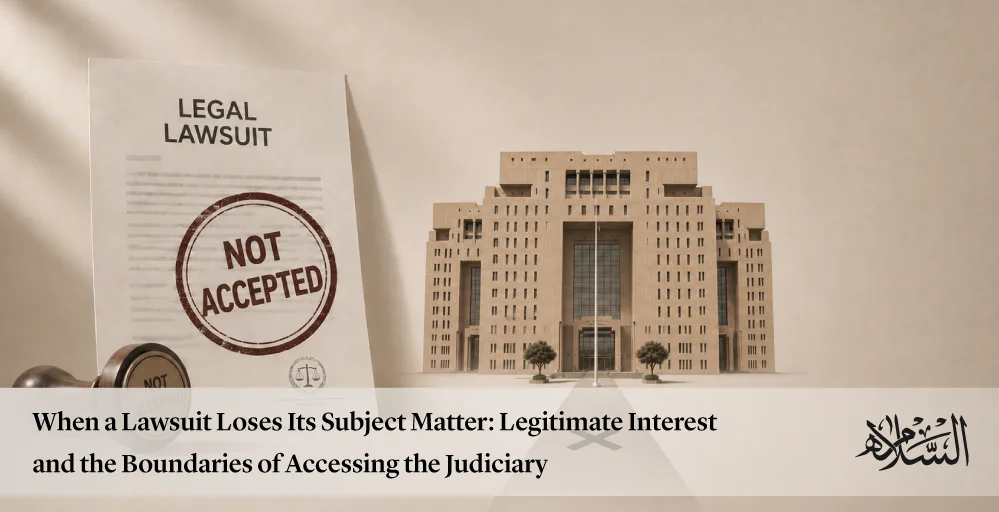
When a Lawsuit Loses Its Subject Matter: Legitimate Interest and the Boundaries of Accessing the Judiciary
A legal analysis of the requirement of legitimate interest pursuant to the Law of Civil Procedure and the Saudi Civil Transactions Law, and the impact of a lawsuit losing its subject matter (such as prior rescission and eviction) upon its admissibility before the courts.
The Function of Judicial Protection and the Substance of a Claim
Not every lawsuit drafted in a statutory structure is worthy of judicial protection. A claim may be sound in its phrasing, conventional in its classification, and apparent on the face of the statement of claim; yet, in reality, it may have lost its subject matter (become moot) prior to reaching the court.
At this juncture, the impediment does not reside in the form of the claim, but in its function: Is the plaintiff seeking the protection of a currently existing right, or is the judiciary being utilized to generate an effect that has already materialized, or to maintain a dispute that no longer possesses a valid justification?
This matter is by no means theoretical. In contractual disputes—particularly those arising from leases, operation agreements, and real estate investments—an action may be initiated seeking the judicial rescission (termination) of a contract, notwithstanding that the contract has already been rescinded pursuant to an extrajudicial contractual mechanism. Similarly, a lawsuit may be filed seeking eviction, despite the fact that the premises have been vacated and possession has been relinquished. In such scenarios, the litigation is framed prima facie as an action to protect a right, whereas its practical reality is a maneuver to project the relationship as ongoing, as a pretext to engineer financial liabilities, leverage negotiations, or exert procedural pressure.
Legal Interest Is Not a Formalistic Phrase on the Face of the Statute
Article 3 of the Law of Civil Procedure enacts a governing rule over the admissibility of lawsuits, petitions, and defenses: No petition or defense shall be admissible unless the propounder thereof possesses an existing, legitimate interest (Standing/Legal Interest). The same rule decrees that simulated (sham) or malicious actions shall be dismissed whenever such characterization becomes apparent to the court.
The efficacy of this Article does not reside in its function as a formal condition precedent to admissibility; rather, it serves as a judicial instrument to test the substance of the claim: Will the requested judgment add an actual element to the legal position of the plaintiff? Or is the claim non-dispositive, has lost its subject matter, or is utilizing the judiciary for a purpose foreign to that for which it was enacted?
Consequently, it is legally insufficient for a plaintiff to merely assert: “I petition for the rescission of the contract,” or “I petition for eviction.” The more critical inquiries are:
- Does the contract still exist as an operative subject matter capable of rescission?
- Do the premises remain under the counterparty’s possession in a manner constituting a withholding of occupancy?
- Does the requested judgment protect an existing right, or does it merely manufacture a new instrument for a dispute whose underlying cause has terminated?
Petitioning for Rescission Post-Rescission: When a Judgment Becomes Non-Dispositive
In a judgment rendered by the Commercial Court of Appeal, the panel decreed the inadmissibility of a petition for contractual rescission where it was substantiated that the contract had already been rescinded, anchoring its ratio decidendi upon Article 3 of the Law of Civil Procedure. The court reasoned that no existing interest resides in reviewing a petition to rescind an already rescinded contract, and that the court’s review is strictly confined to the specific remedies sought in the statement of claim, not to external effects that have not been precisely pleaded.
This jurisprudential trend is critical in contractual practice; it curtails attempts to utilize an action for rescission as an alternative vehicle for unasserted claims. If the substance of the dispute is a financial claim, an accounting, or damages, it must not be cloaked in the guise of “contractual rescission” if rescission has already been perfected. The judiciary is not invoked to recreate an existing effect, nor to infuse formalistic life into an extinguished relationship, but to adjudicate a right that remains the subject of an actual controversy.
Conventional Rescission Does Not Invariably Require a Constitutive Judicial Decree
The Civil Transactions Law has reinforced the supremacy of contractual provisions in regulating the destinies of contracts. Article 108 explicitly permits the transacting parties to agree that a creditor shall possess the right to rescind the contract upon the debtor’s breach of obligations without the necessity of obtaining a judicial decree (Lex Commissoria), subject to the rules of formal notice (Putting in Default) as agreed upon by the parties or mandated by law.
While the invocation of this Article is contingent upon the precise drafting of the clause, its underlying cause, and the circumstances of the instrument, it affirms a central doctrine: Not every rescission requires a constitutive judicial decree. On certain occasions, the subsequent role of the court is strictly declaratory or supervisory over the legality of the rescission and its effects, rather than being the source that constitutes the rescission itself.
Therefore, when an instrument confers an explicit right of termination or rescission upon a party subject to specified conditions, and that right is exercised in the agreed-upon manner, a subsequent lawsuit seeking judicial rescission may be dismissed for lack of legal interest, as there is no longer a viable subject matter for a decree of rescission.
The practical hazard here lies in the commingling of two distinct concepts: a party’s right to dispute the consequences of rescission, and their purported right to seek the rescission of an instrument that has already been terminated. The former may be legitimate if precisely pleaded; whereas the latter devolves into a non-dispositive action if the court is being requested to decree an effect that has already materialized.
Eviction Is Not a Mere Signature on a Protocol
In real estate disputes, the complication manifests with greater intricacy. A party may condition eviction upon a written protocol, a signature, or physical attendance, while the objective reality indicates that the tenant has surrendered possession of the premises and enabled the landlord to take delivery. Here, the judicial inquiry grows more precise: Which party obstructed the handover? Did the premises remain under the tenant’s possession for actual enjoyment and withholding, or was the continuity of the physical situation caused by the counterparty’s procrastination or refusal to take delivery?
Settled Judicial Principles Governing the Handover of Real Property: Saudi jurisprudence has established in multiple precedents that the delivery of real property is perfected via relinquishment of possession (Takhliyah), and that the tenant’s lifting of their hand from the leased premises and vacating the same is a direct consequence of the expiration of the leasehold estate.
Furthermore, commercial adjudication has ruled that the baseline obligation of a tenant upon the expiration of a lease is to lift their hand from the premises, and they are not obligated to effectuate a physical return nor bear its costs unless a specific covenant dictates otherwise.
These principles do not absolve a tenant from complying with contractual stipulations, but they prevent a landlord’s refusal or procrastination in taking delivery from being transformed into a mechanism to extend the liability for rent without judicial scrutiny. Therefore, in real estate instruments, it is legally insufficient to state in a pleading that the premises “were not delivered.” The underlying facts must be examined:
- Was a relinquishment of possession (Takhliyah) perfected?
- Was the tender of keys effectuated?
- Did an impediment originate from the tenant?
- Did the landlord refuse to take delivery for a reason extraneous to the mechanism of handover?
These inquiries determine whether the petition for eviction retains a valid subject matter or has devolved into a facial claim devoid of legitimate interest.
The Prohibition Against the Abuse of Process
The right to access the judiciary is a constitutionally guaranteed prerogative, yet it is not an absolute right detached from its underlying purpose. Its function is the protection of rights and the aversion of harm, not the retention of an adversary within a sphere of litigation merely to exert pressure, enhance a negotiating posture, or manufacture an indirect financial effect.
At this juncture, the Law of Civil Procedure converges with the Civil Transactions Law:
- The Law of Civil Procedure mandates an existing, legitimate interest.
- The Civil Transactions Law codifies the prohibition against the abuse of rights, including the exercise of a right for an illegitimate purpose or in a manner that deviates from its intended design.
The gravity of an abuse of process becomes distinct when a non-dispositive remedy is selected because it is procedurally simpler or psychologically more coercive, while the actual substantive claim is left unprecised. In such a scenario, the lawsuit is not devoid of facts, but it is entirely devoid of a legitimate judicial function. A vast distinction separates a lawsuit seeking the protection of an existing right from a lawsuit utilizing an extinguished claim to restructure a dispute anew.
What Does This Imply for Corporations and Investors?
1. The Quality of Proactive Contractual Drafting
Contracts must be engineered to delineate with absolute certainty:
- The exact milestones and mechanisms governing the expiration of the instrument.
- The protocol for exercising the right of rescission and the corporate officers authorized to invoke it.
- The statutory effects attached to formal notifications and defaults.
- The contractually approved mechanism for eviction and relinquishment of possession.
- The legal consequences arising from a party’s refusal or failure to take delivery or sign protocols.
Every ambiguity in these core milestones subsequently devolves into protracted litigation regarding whether rescission was perfected, whether eviction was achieved, or whether rent remains an outstanding liability in the debits of the counterparty.
2. Delineating the Dispositive Judicial Remedy
A litigation strategy must initiate with a fundamental inquiry prior to the drafting of the statement of claim: What is the dispositive remedy in this specific instance?
- If the contract has already been rescinded: The proper remedy is not an action for “rescission,” but rather an action to establish the effects of the rescission, a claim for outstanding dues, damages, or an accounting dictated by the facts.
- If the premises have been physically vacated: A petition for eviction is not the correct procedural path; instead, the core of the dispute must be directed toward the financial consequences, liability for waste/damages, or delivery pursuant to the contractual mechanism.
The commingling of these remedies is not a minor drafting error; it may directly induce the dismissal of the action or a judgment of inadmissibility, thereby equipping the defendant with a powerful substantive defense that the lawsuit has lost its subject matter and fails to achieve any existing, legitimate interest for the claimant.
Conclusion
A potent lawsuit is not one that multiplies remedies, but one that isolates the dispositive remedy. If rescission has been achieved, eviction has occurred, or the requested effect has already materialized, reasserting it before the court adds nothing but redundant litigation.
In a highly regulated contractual ecosystem, the quality of drafting prior to the dispute, and the precision of characterizing the remedy upon the dispute, constitutes the definitive variance between a lawsuit that insulates a right and a lawsuit that loses its subject matter before it even initiates.
Frequently Asked Questions (FAQs)
Q1: What is the judicial outcome if a plaintiff petitions for the rescission of a contract that has already been terminated extrajudicially?
A: Pursuant to Article 3 of the Law of Civil Procedure, the court will render a judgment of inadmissibility (dismissal without prejudice) due to the lack of an existing, legitimate interest, as the judiciary cannot be invoked to decree a contractual termination that has already been perfected.
Q2: Is a landlord entitled to claim rent for a duration following the tenant’s physical vacating of the premises if no formal handover protocol was signed?
A: If it is substantiated that the tenant completely lifted their hand from the property and placed it at the absolute disposal of the landlord (Takhliyah), the tenant’s primary obligation is discharged. A landlord’s failure or procrastination in taking delivery cannot be utilized as a mechanism to artificially extend the leasehold liabilities, unless a specific valid covenant dictates otherwise.
Q3: How does the prohibition against the abuse of rights intersect with the right to file a lawsuit?
A: While accessing the courts is guaranteed, utilizing litigation for an illegitimate purpose—such as initiating a non-dispositive or moot action solely to exert financial pressure or manipulate negotiations—constitutes an abuse of rights under the Civil Transactions Law, exposing the abusing party to potential claims for damages and the dismissal of their action.