How the Registration of Rights and Obligations Transformed Real Estate Due Diligence and Risk Assessment
In institutional real estate transactions, risk does not merely materialize on the day a dispute is formally litigated; rather, it is often born much earlier—specifically, on the day a purchaser, property manager, or fund manager assumes that an asset’s legal standing is completely transparent based solely on a surface review of the title deed (Saq Al-Milkiyyah), the purchase price, and apparent yield indicators. This rudimentary perspective is no longer legally or commercially viable. Following the implementation of the In-Kind Registration system, the pivotal inquiry is no longer simply: Who owns the property? Instead, it has shifted to: What encumbrances, in-kind rights, obligations, restrictions, cautionary notices, and statutory conditions tether this asset, and how do they impact its valuation, transferability, financeability, and developmental feasibility?
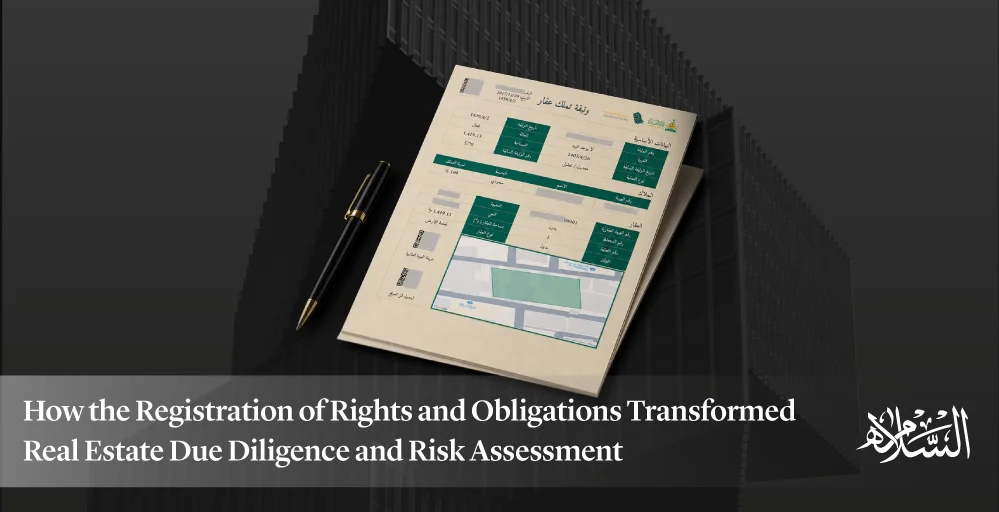
This, in our assessment, represents the most profound paradigm shift brought about by the In-Kind Registration of Real Estate. The framework was not enacted merely to alter the aesthetic layout of a title document or digitize the archiving channel; rather, it was engineered to fundamentally redefine how a real estate asset must be legally audited. When the Implementing Regulations structured the Real Estate Ledger (Sahifat Al-Aqar), they did not design it as a mere tool to verify the owner’s identity. Instead, it was established as a definitive, comprehensive document detailing the asset’s technical parameters, precise coordinates, physical and statutory condition, derivative rights, reciprocal obligations, and any subsequent modifications.
Furthermore, because the Real Estate Registry establishes a completely independent ledger for each distinct property parcel, all derivative rights are legally tied to the asset itself. This localized architecture preserves all underlying deeds, traces historic title chains, and tracks structural modifications, rendering legal audits significantly more disciplined and precisely aligned with the true nexus of transaction risk.
The Real Estate Legal Due Diligence Framework
Consequently, legal due diligence (Al-Fahs Al-Nafi Lil-Jahalah) has graduated from a routine verification of root title to an exhaustive audit of the asset’s entire statutory ecosystem. The inquiry must now comprehensively determine: Are there registered in-kind rights encumbering the property? Are there material reciprocal obligations tied to its usage? Are there active restrictions blocking disposal or alienation? Have cautionary notices (Ta’sheerat), definitive judicial judgments, active litigations, or secondary claims been formally docketed against the ledger? Are there specific master-plan data, zoning classifications, environmental permits, or restricted uses that could disrupt development, financing, or exit strategies?
These are not ancillary, administrative details; they are core elements that dictate the investment thesis itself. The true value of a real estate asset can never be calculated solely from its geographic location, surface area, and apparent cash flows; it must be appraised based on the absolute clarity of its underlying rights and cross-cutting liabilities.
It is by no means an accidental detailing that the Implementing Regulations expressly mandated that the Real Estate Ledger must contain: in-kind rights, the identities of all beneficial owners along with their exact equity percentages, a granular breakdown of all reciprocal rights and obligations including their inception dates and counterparties, disposal restrictions, mandatory cautionary notices, final judicial decrees, and all regulatory permits concerning the asset’s zoning and utilization.
Furthermore, the statutory framework went a step further by explicitly empowering any prospective transferee or purchaser to formally inspect and review the entirety of the Real Estate Ledger’s data prior to executing and authenticating any transaction. The legal significance of this mechanism is monumental: it shifts the due diligence process from a superficial, formalistic review of a deed into an integrated legal and investment analysis of the property’s ledger and its practical consequences on the transaction’s pricing model.
An Owned Asset is Not Necessarily a Comprehended Asset
Here, a highly sophisticated yet critical professional distinction emerges in practice: not every owned asset is a comprehended asset. A property may feature perfectly undisputed ownership on its face, yet remain structurally un-disciplined regarding underlying registered rights, derivative liabilities, disposal restrictions, or statutory non-compliance that directly impairs its commercial exploitation, financeability, and development.
A truly “comprehended” asset is one where the underwriting team not only knows the identity of the registered owner, but thoroughly understands the structural liabilities the asset carries, the encumbrances that restrict its operational freedom, and the hidden factors that could erode its valuation or disrupt a future exit strategy.
This regulatory consideration intensifies exponentially as the scale of the asset grows. An individual retail purchaser might—albeit reluctantly—absorb a minor legal surprise or tolerate an administrative delay in clearing a latent restriction. However, an institutional fund manager, portfolio allocation officer, or master developer bringing a mega-asset into a structured investment vehicle, corporate trust, or capital market facility does not merely face a generic “legal issue.” They face a material disruption that directly impairs asset valuation, financing leverage, dividend distributions, regulatory disclosures, and the fiduciary integrity of the investment decision itself. For institutional capital, comprehensive due diligence is neither a legal luxury nor a perfunctory pre-signing check; it is the very core of the duty of care expected from anyone managing, underwriting, or financing real estate assets.
This reality was forcefully demonstrated in a landmark commercial litigation involving a prominent Saudi bank. The bank asserted a preferential right over certain real estate assets based on a mortgage executed in its favor by the debtor. However, the Court ultimately ruled that because the mortgage had failed to be formally registered in accordance with the mandatory statutory requirements, it carried no legal effect against third parties (Hujjiya Alal-Ghayr), remaining binding solely as an in-personam contract between the immediate signers. Consequently, the unregistered mortgage could not be enforced against the debtor’s wider pool of competing creditors, and the Court rejected the bank’s petition to foreclose on the properties.
The profound significance of this precedent does not merely lie in validating registration theory; it exposes its raw, commercial consequences: an economic right, irrespective of its financial scale or underwriting importance, cannot achieve its legal utility if it remains a mere un-registered agreement that has failed to navigate its mandatory statutory registration path. Risk in real estate transactions does not stem exclusively from the existence of an underlying right or liability; it stems from the failure to register that right in a manner that renders it legally enforceable, perfected, and opposable against the world.
This judicial precedent alone perfectly illustrates the chasm between a rudimentary legal review that contents itself with the mere existence of a signed document, and an elite legal audit that rigorously tests that document’s enforceability, opposability, and statutory priority. In legacy transactional environments, a review team might ask: Is there a mortgage? Is there an obligation? Is there a right? Conversely, the mature underwriting methodology demanded under the In-Kind Registration framework is: Has this right successfully navigated its mandatory statutory path of registration or cautionary docketing? Can it be decisively relied upon in active litigation? And is it recognized as a perfected interest against competing third parties? This is precisely where specialized legal expertise transforms from an administrative drafting service into a strategic shield protecting institutional capital.
The Real Estate Ledger as a Risk Redistribution Mechanism
It is critical to emphasize that the In-Kind Registration system did not completely eliminate or wipe real estate risks out of the market. More accurately, it completely redistributed them, fundamentally shifting their center of gravity. Rather than leaving risks buried in fragmented corporate archives, ambiguous historical agreements, or un-disclosed obligations, a significant portion of transaction risk now revolves around the accuracy of registration, the public visibility of mandatory data, the execution of proper cautionary notices, the real-time updating of the Real Estate Ledger, and the sophisticated interpretation of what is—or should have been—recorded within that ledger.
Consequently, professional negligence post-In-Kind Registration is no longer defined by failing to identify who holds title; rather, it is triggered by misinterpreting the operational impacts disclosed within the ledger, overlooking the consequence of a visible restriction, or relying on an in-kind interest that has failed to satisfy its mandatory statutory registration path.
Accordingly, high-value real estate transactions today require a complete re-engineering of the due diligence methodology. Rather than beginning and ending with basic ownership verification, the audit must treat ownership as a mere starting point. It must aggressively extend to scrutinizing registered in-kind rights, disposal blocks, active cautionary notices, pending judicial decrees, and municipal permits, tracing how each vector impacts utilization, development, and financing.
Furthermore, the findings of this legal audit must be directly integrated into the architecture of the definitive agreements—specifically shaping the representations and warranties (R&Ws), specific indemnities, conditions precedent (CPs) to closing, and purchase price adjustment mechanisms, including holding a portion of the consideration in escrow or linking performance milestones to the formal rectification of specific ledger entries or statutory conditions.
The definitive takeaway for real estate professionals today is not merely that In-Kind Registration is “beneficial”—a generic statement that offers no strategic value. The true consequence is that it has drastically elevated the standard of professional care (Me’yar Al-Inayah Al-Mihaniyyah) demanded of anyone purchasing, managing, or financing a real estate asset. Under this framework, real estate can no longer be audited simply as a piece of property ownership; it must be audited as a complete, multi-layered statutory position.
An acquisition team that fails to interpret this position accurately may successfully purchase an asset that appears flawless on its face, only to find they have inherited an unenforceable interest, a paralyzing restriction, an uncalculated liability, or a transaction-altering risk that could have been completely exposed before closing had the Real Estate Ledger been scrutinized through a proper institutional lens. This is the true power of the registration of rights and obligations: it did not merely expand data availability; it fundamentally re-engineered the cognitive framework of real estate transactions. Due diligence is no longer a supportive pre-signing formality; it is the core of the asset’s legal and investment governance.