Operational breaches at franchise outlets: documentation before termination
A franchisee’s outlet may achieve strong sales, only for you to discover that it is not meeting brand standards. Sales continue, but the brand’s reputation deteriorates. The franchisor faces a difficult choice: intervene firmly and risk losing a profitable outlet, or leave matters unchecked and risk the entire brand.
The question is not whether the franchisor may intervene. It is how to intervene without jeopardising its contractual position in court.
How should a company document breaches of quality and brand identity standards?
Inspection rights are the first tool. The Franchise Law gives the franchisor or its representatives the right to inspect authorised premises during normal business hours. The franchisee and its employees must cooperate fully and provide support during the inspection. This right is more than a formality. It allows the franchisor to identify departures from standards before they become a crisis.
But the right alone is not enough. A franchisor that visits an outlet, identifies a breach, and merely raises it verbally has nothing to rely on later. The court considers what the franchisor can establish through documentary evidence, rather than simply what it saw.
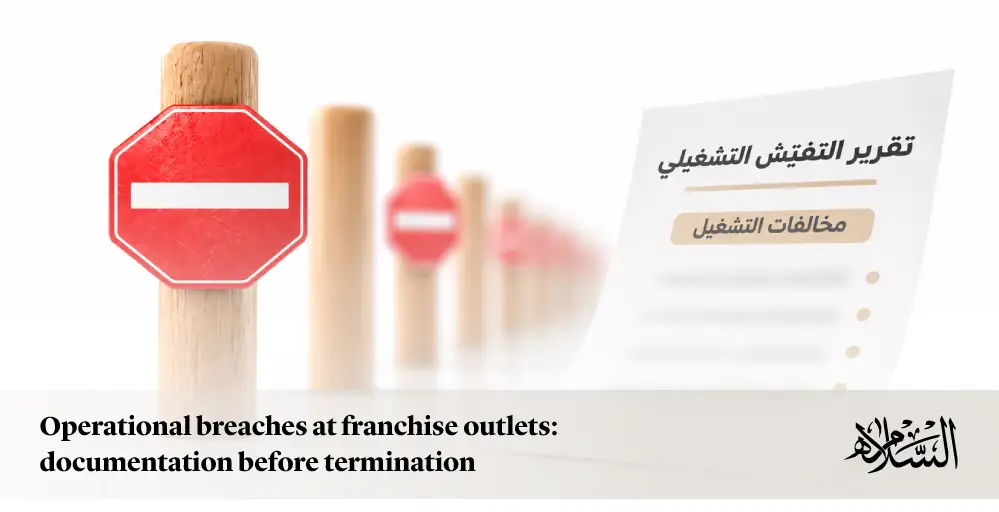
Documentation begins with the inspection itself. The franchisor needs a written inspection form identifying the standards examined, the observations made, and the breaches recorded. The form should be signed by the franchisor’s representative and delivered to the franchisee or its representative at the outlet. If the representative refuses to sign, that refusal should be recorded in the inspection report, and the form should be sent to the franchisee through a method that provides evidence of receipt, such as email or another electronic method recognised in the agreement.
Is identifying a breach enough to terminate the agreement?
No. Identifying the breach alone is insufficient. Written notice turns an observation into a formal legal step. The notice must precisely identify the breach, the standard breached, the action required to remedy it, and the period allowed. The statutory period for remedying a material breach is fourteen days from the date written notice is given. This period is not a formality; it is a right of the franchisee. A franchisor that terminates without allowing this period exposes the termination to a legal challenge.
However, not every breach requires fourteen days. Some breaches affect public health and safety or pose a direct threat to the brand’s reputation. In these circumstances, there may be immediate legitimate grounds for termination if the franchisee’s operation of the franchise business is shown to pose a risk to public health and safety. The distinction between a breach requiring a remedy period and one that does not depends on the nature of the breach and the extent of the potential harm.
The third aspect of documentation is the evidentiary record. A franchisor relying on a single inspection report to establish a pattern of repeated breaches is in a weak position. A prepared company maintains a file for each outlet containing inspection reports, notices sent, the franchisee’s responses, complaint reports, and sales records that may show that higher sales were linked to lower standards. Documenting a pattern of breaches is stronger than documenting an isolated incident.
What procedures should precede termination for operational breaches?
Termination is the last resort. A franchisor that begins with termination before exhausting intermediate measures puts itself in a difficult position. A franchise agreement creates an ongoing relationship, rather than a one-off sale. An ongoing relationship requires a graduated approach.
The first step is a notice to remedy the breach. After identifying and documenting the breach, the franchisor sends written notice specifying the breach, the action required, and the deadline. This gives the franchisee an opportunity to correct its course. A franchisee that responds and remedies the breach does not have its agreement terminated. A franchisor that disregards this procedure and rushes to terminate loses in court, even if the breach is established.
The second step is follow-up. Once the remedy period expires, the franchisor returns to the outlet to verify whether the breach has been remedied. If it has, this is documented in a new report. If it has not, the failure to remedy it is documented. This documentation turns a remediable breach into a material breach justifying termination.
The third step is a documented remedial meeting. If the breach reaches a level that threatens the brand, the franchisor may invite the franchisee to a documented meeting attended by the manager responsible for operations. The purpose is to agree on a remedial plan with a defined timetable, rather than merely issue a warning. If the franchisee agrees to and signs the plan, it becomes a contractual basis on which the franchisor may later rely. If the franchisee refuses, that refusal should be documented.
The fourth step is gradual escalation. A franchisor facing repeated breaches or a pattern of non-compliance should not wait for breaches to accumulate. It should use the contractual tools available, such as suspending the supply of products, tools, or marketing materials where the franchisee has breached a provision of the agreement. Some agreements allow the franchisor to suspend or cancel orders, in whole or in part, until the franchisee remedies the breach. This measure restores discipline to the relationship and makes remedying the breach a condition for continued supply.
The fifth step is the termination notice. If the preceding measures fail, termination becomes lawful in specified circumstances. These include a failure by the franchisee to remedy a breach of its material obligations within the statutory period, repeated non-compliance after written notice, material violations adversely affecting the franchise business’s reputation, or an act of commercial fraud. The termination notice must be in writing, identify the grounds, and rely on the accumulated documentation.
Termination does not end the dispute
A franchisor that lawfully terminates the agreement has not necessarily eliminated its exposure. Termination may create financial obligations. If the franchisee requests termination in circumstances permitting it to do so, the franchisor terminates in breach of the Law, or the franchisor refuses renewal on unlawful grounds, the franchisor may be required to repurchase tangible assets. The termination decision is therefore a financial decision as well as an operational one.
This is where documentation becomes essential. A franchisor with a documented record of notices, reports, meetings, and complaints is positioned to establish that termination was based on legitimate grounds. A franchisor relying on personal knowledge of breaches without supporting documents finds itself trying to prove what it already knows. The court decides on what a party can prove, rather than what it knows.
Before terminating a franchise agreement for operational breaches, your company should ask more than whether the breach is established. It should ask: do I have a documented record of notices, remedy periods, and follow-up reports that supports the lawfulness of termination in court?
Frequently asked questions
May the franchisor inspect the franchisee’s outlets without prior notice?
Yes, if the franchise agreement permits this.
The Franchise Law gives the franchisor or its representatives the right to inspect authorised premises during normal business hours, and the franchisee must cooperate fully. Some agreements allow inspection without prior notice, while others require advance notification. An unannounced inspection reveals the outlet’s actual condition when it has not prepared for inspection.
What is the statutory period for remedying a breach before termination?
Fourteen days from the date written notice is given.
Lawful grounds for termination include a breach of the franchisee’s material obligations that remains unremedied within a period not exceeding fourteen days from the date the franchisor gives written notice. Some breaches, such as those posing a risk to public health and safety, may not require this period.
What should be documented when a breach is identified at a franchise outlet?
Three elements: the breach itself, the written notice, and the follow-up report after the remedy period expires.
The inspection should be documented in a written form signed by the franchisor’s representative. Written notice should then identify the breach, the action required, and the deadline. Once the period expires, a further inspection should document whether the breach has been remedied or continues. This record turns the breach from an observation into legitimate grounds for termination.
Can the agreement be terminated immediately if the breach affects the brand’s reputation?
Yes, if the breach is material and adversely affects the franchise business’s reputation, or poses a risk to public health and safety.
Lawful grounds for termination include material violations by the franchisee of applicable laws in the Kingdom that adversely affect the franchise business’s reputation, or a risk to public health and safety. In these circumstances, allowing a remedy period may be insufficient because the harm may already have occurred.
What procedures should precede termination if the franchisee is achieving strong sales?
The same procedures apply, but the documentation must show that the higher sales were linked to lower standards.
The franchisor terminates for breach, rather than for low sales. Where sales are high, the franchisee may argue that termination unjustifiably harms its interests. The franchisor should therefore document the connection between strong sales and reduced standards, establishing that those sales were achieved at the expense of the brand’s quality.
Can the franchisor suspend product supplies if the franchisee fails to remedy the breach?
Yes, if the agreement grants this right.
Some agreements allow the franchisor to cancel or suspend orders for products, tools, or marketing materials, in whole or in part, if the franchisee breaches any provision of the agreement, until the breach is remedied. This measure restores discipline to the relationship and makes remedying the breach a condition for continued supply.