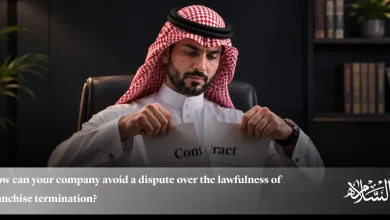
How can your company avoid a dispute over the lawfulness of franchise termination?
The decision a franchisor makes with the greatest confidence may be the one that exposes it to its largest dispute. It identifies a breach at a franchise outlet, decides to terminate the agreement, and sends notice. It then discovers that the franchisee is challenging the termination, seeking compensation, and potentially demanding the repurchase of assets. What the franchisor thought was a decisive step becomes the starting point of an unforeseen dispute. Often, the problem is not the absence of a breach, but a failure to follow the procedures prescribed by law.
The Saudi Franchise Law does not leave termination entirely to the franchisor’s discretion. It establishes a clear rule: a franchisor may not terminate a franchise agreement before its term expires without the franchisee’s written consent unless there are legitimate grounds for termination. Termination is therefore a right conditional on grounds, rather than an absolute right. The Law specifies the circumstances constituting legitimate grounds. Termination outside those circumstances—or within them but without satisfying the applicable procedures—is unlawful and creates exposure to liability.
Legitimate grounds for terminating a franchise agreement
The first and most common ground is a material breach of the franchisee’s obligations that remains unremedied within the statutory period. This requires more than an ordinary breach. An ordinary breach does not affect the substance of the relationship, while a material breach concerns an essential obligation under the agreement. The statutory period for remedying a material breach is fourteen days from the date written notice is given. Termination before that period expires, or without written notice at all, is unlawful even if the breach is established. The period is a right of the franchisee, rather than a formality. Providing an opportunity to remedy the breach is a condition for lawful termination.
The second ground is the franchisee’s liquidation or dissolution, assignment of the franchise business or the benefit of it to its creditors, or disposal of assets relating to the franchise business to a third party. This concerns a legal or financial position that makes continuation of the relationship impossible, rather than an operational breach. A franchisee that disposes of franchise assets to someone other than the franchisor, or whose business enters liquidation, can no longer fulfil its obligations. Termination here is an inevitable consequence, rather than a penalty.
The third ground is the franchisee’s abandonment or voluntary cessation of the franchise business for more than ninety consecutive days. Abandonment or voluntary cessation means a complete interruption of activity, rather than merely declining performance. The ninety days are not a remedy period; they are a period after which the franchisor may conclude that the franchisee no longer wishes to continue. Cessation caused by an external event, such as mandatory closure or force majeure, does not fall within this ground.
The fourth ground is repeated failure by the franchisee to comply with the franchise agreement or another agreement concluded with the franchisor or a member of its group, despite written notice requiring compliance. The latest breach need not itself be material. A pattern of non-compliance following written notice is sufficient. Repetition turns an ordinary breach into legitimate grounds for termination because the franchisor has established that the problem is continuing conduct, rather than an isolated incident.
The fifth ground is that the franchisee’s operation of the franchise business poses a risk to public health and safety. This does not require a remedy period because the risk cannot wait. It does, however, require objective evidence, rather than a mere allegation. A franchisor relying on this ground should hold a report, certificate, or document establishing the risk, rather than relying on a personal observation.
The sixth ground is the franchisee’s loss of any licence required to conduct its business. A licence is more than an administrative requirement; it is a condition for lawfully operating the business. Losing it means that the franchisee cannot legally continue operating. Termination here reflects impossibility of performance, rather than breach.
The seventh ground is the franchisee’s commission of material violations of applicable laws in the Kingdom that adversely affect the franchise business’s reputation. This concerns compliance with the law, rather than the agreement alone. A violation affecting the brand’s reputation, whether commercial, regulatory, or otherwise, gives the franchisor a right to terminate. The reputational effect must, however, be real rather than assumed. A franchisor relying on this ground without evidence of harm to the brand is in a weak position.
The eighth ground is the franchisee’s commission of an act of commercial fraud when operating the franchise business. Fraud is conduct that undermines the foundation of the contractual relationship and the trust on which the franchise was built, rather than an ordinary breach.
The ninth ground is the franchisee’s infringement of the franchisor’s intellectual property rights during the franchise agreement’s term. Infringement of the trademark, trade name, or any other intellectual property right affects the substance of what was granted under the franchise. Termination protects the right forming the basis of the relationship, rather than merely punishing the infringement.
The tenth ground is any other circumstance that the franchise agreement expressly identifies as legitimate grounds for termination. This allows the parties to agree on additional grounds, provided that they are clearly and specifically stated in the agreement. A franchisor relying on an unwritten ground cannot assert that it is legitimate unless it falls within one of the preceding circumstances.
When does a breach become grounds on which termination can be exercised?
Notice is not a formality that can be bypassed. It turns a breach from theoretical grounds for termination into grounds on which the right may be exercised. The period is fourteen days from the date notice is given, but the notice itself must satisfy certain requirements.
The notice must be in writing. Oral notice is insufficient. Writing does not necessarily mean a paper letter: an electronic method recognised in the agreement may suffice. A franchisor relying on a method not specified in the agreement may face a dispute over the notice’s validity.
The notice must identify the breach. Simply stating “you are in breach” is insufficient. It should specify the obligation breached, the standard not met, and the incident identified. A general notice that does not identify the breach gives the franchisee no meaningful opportunity to remedy it and does not fulfil the notice’s purpose.
The notice must specify the remedial action required. The franchisee needs to know what it must do to correct the position. If an operational breach must be remedied, the necessary action should be identified. If payment is required, the amount should be specified. An unclear demand does not relieve the franchisor of the requirement to provide an opportunity to remedy the breach.
The notice must allow the required period: fourteen days from the date it is given. This period runs from the notice date, rather than the date the franchisee becomes aware of it. If the franchisor sends the notice to an incorrect address or an unauthorised recipient, the period does not begin. If the franchisee refuses receipt, that refusal should be documented.
Not every breach requires a remedy period, however. A breach posing a risk to public health and safety may allow termination without a remedy period because the risk cannot wait. A breach materially affecting the brand’s reputation may justify a shorter period or no period, depending on the nature of the harm. The distinction depends on the type of breach and the extent of the potential harm.
Financial consequences of unlawful franchise termination
A franchisor that unlawfully terminates the agreement or refuses renewal on unlawful grounds may face financial obligations it had not anticipated. In specified circumstances, the Law requires the franchisor to repurchase tangible assets used exclusively in the franchise business that the franchisee purchased from the franchisor or from others at its direction. Repurchase must take place within sixty days of the franchisee’s request, at a price no lower than the amount paid by the franchisee, less depreciation of the equipment or fittings calculated in accordance with generally accepted accounting standards.
These obligations do not arise on every termination, but only in specified circumstances. If termination is lawful on one of the grounds specified by the Law, the franchisor is not required to repurchase the assets. If termination is unlawful, or renewal is refused on unlawful grounds, a repurchase obligation may arise. The distinction is between termination supported by lawful grounds and termination without them. A franchisor that terminates without grounds or without completing the required procedures places itself in the latter position.
Time limit for bringing a compensation claim for unlawful franchise termination
A claim for compensation arising from unlawful termination of a franchise agreement will not be heard after three years from the termination date. This period governs when proceedings must be brought, rather than when the right arises. A franchisee that knows of the unlawful termination but does not bring its claim within three years loses its right to pursue the claim, even if termination was unlawful.
The limitation period therefore concerns the passage of time before pursuing the claim, rather than the existence of the right itself. The Law sets a maximum period of three years for bringing the action. After that, the claim will not be heard, even if the termination was substantively invalid.
In addition to repurchasing assets, the franchisor may be required to compensate the franchisee for damage resulting from unlawful termination. This right is not available indefinitely. It is subject to a limitation period within which the franchisee must act or lose its right.
The practical takeaway
Termination is a legal decision with conditions, grounds, and procedures, rather than an operational decision to be made in anger or out of concern for the brand. A franchisor wishing to terminate a franchise agreement for breaches should establish three things: does the breach fall within a recognised ground for termination? Has it been documented sufficiently to establish it? And has the franchisee been notified and given the required period before termination? Unless the answer to each question is yes, a substantively justified decision may still fail in court because of a procedural defect.
Before sending a termination notice, every franchisor should ask more than whether the breach is established. It should ask: have I satisfied the grounds and procedures that make termination lawful, or am I exposing myself to a dispute that could result in asset repurchase obligations and compensation?
Frequently asked questions
May the franchisor terminate the agreement without the franchisee’s consent?
Yes, where there are legitimate grounds recognised by the Law. The general rule is that the franchisor may not terminate before the agreement expires without the franchisee’s written consent unless legitimate grounds exist. Those grounds are specified in the Law and may not be extended by analogy or broader interpretation beyond the circumstances provided for in the agreement.
What is the statutory period for remedying a material breach before termination?
Fourteen days from the date written notice is given. If the franchisee breaches its material obligations and fails to remedy the breach within fourteen days of the franchisor giving written notice, legitimate grounds for termination arise. Termination before the period expires, or without written notice, is unlawful.
Can the agreement be terminated immediately if there is a risk to public health and safety?
Yes, because the risk cannot wait. If the franchisee’s operation of the franchise business poses a risk to public health and safety, legitimate grounds for termination exist without a remedy period. The risk must, however, be established through objective documentary evidence, rather than a mere allegation.
What happens if the franchisor unlawfully terminates the agreement?
It may be required to repurchase tangible assets and compensate the franchisee for damage. If the franchisor terminates in breach of the Law, it must repurchase tangible assets used exclusively in the franchise business within sixty days of the franchisee’s request, at a price no lower than the amount paid by the franchisee less depreciation. It may also be required to compensate the franchisee for damage suffered.
What is the time limit for bringing a compensation claim for unlawful termination?
Three years from the termination date. Claims for compensation arising from the franchisor’s termination of the agreement in breach of the Law will not be heard after three years from termination. A franchisee that knows of the unlawful termination but does not bring its action within that period loses its right to pursue the claim.
What should be documented before sending a termination notice?
The breach itself, the written notice, the period allowed, and the follow-up report. The breach should be recorded in a written report, followed by written notice identifying the breach, the action required, and the deadline. Remedial action should then be checked after the period expires. Without this documented record, the franchisor cannot establish that termination was based on legitimate grounds and followed the required procedures.