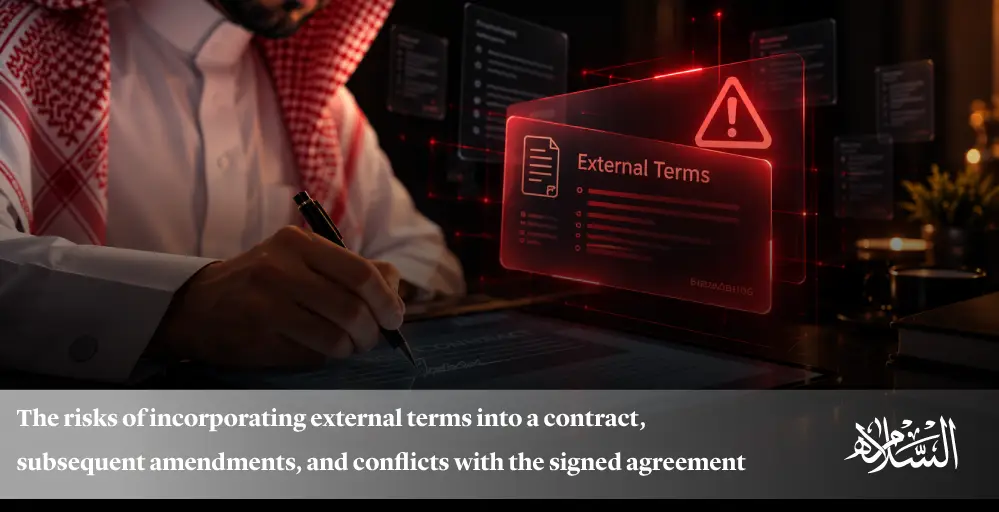
The risks of incorporating external terms into a contract, subsequent amendments, and conflicts with the signed agreement
Many commercial contracts contain a single sentence stating: “This agreement is subject to the terms of service published on the provider’s website, which form an integral part of this contract.” This sentence may seem harmless. In practice, however, it turns the contract from a fixed document into an open-ended one that can be changed unilaterally. Every decision-maker should ask: do you know which terms you actually agreed to?
The issue is not the parties’ intention. It is that the contract your company signed may refer to a document you have not read, monitored, or agreed to in its final form. This type of reference is not a minor clause. It is a mechanism that may change the liability cap, the dispute resolution mechanism, or the notice period without anyone signing off on the change.
Reference to external terms: a small clause with a substantial effect
Many contracts refer to external terms. These may be website terms of service, a usage policy, an operating manual, or an annex that has not been attached. The reference may seem harmless. In practice, however, it turns the contract from a fixed document into an open-ended one that can be changed unilaterally.
Article 33 of the Civil Transactions Law permits an intention to be expressed verbally, in writing, through an intelligible sign, or through conduct, and allows that expression to be explicit or implicit. However, referring to a document that has not been provided to the other party may not satisfy the requirement of awareness. If the other party was unaware of the referenced document, it may not be binding on them. The problem is that many companies assume the reference is sufficient, overlooking the fact that awareness is a necessary condition for a valid incorporation by reference.
Is a reference sufficient to make external terms part of the contract?
Legal scholarship and courts in many jurisdictions accept the incorporation of external terms by reference where the other party knows those terms or is able to access them. However, this requires a clear reference, accessible terms, and actual awareness or an opportunity to become aware of them. If the reference is general, the terms are unavailable, or they subsequently change without notice, they may not be binding.
In one case, a services contract stated that “the service is subject to the usage policy published on the provider’s website.” After a dispute arose, it emerged that the policy had changed three times during the contract term. The court held that referring to a changing policy without prior notice was insufficient to make it part of the contract, and that terms of which the customer was unaware were not binding on the customer.
The lesson is that a reference is more than a line in a contract. It entails an obligation to make the other party aware of the referenced terms.
Subsequent amendments: who has the right to change the terms?
One of the most serious risks in contracts that refer to external terms is that the supplier may reserve the right to amend those terms unilaterally. This means that the contract your company signed may change without its consent. The changes may affect material matters, such as the liability cap, the notice period, or the dispute resolution mechanism.
Article 94 of the Civil Transactions Law establishes that a contract is binding on the contracting parties and may not be revoked or amended except by agreement or pursuant to a statutory provision. If the contract gives the supplier the right to amend the terms unilaterally, that clause may conflict with the principle of contractual balance. It may also constitute an unfair term in a contract of adhesion, as addressed by Article 96.
In one case, a subscription contract for an online platform stated that “the provider may amend the terms of service at any time, and the customer’s continued use of the service constitutes acceptance of the amendments.” After the provider amended the terms and increased the prices, the customer objected. The court held that the clause was unfair and that the provider could not impose material amendments without the customer’s express consent.
Conflicts between external terms and the signed contract
Even where the external terms are known and accessible, another problem may arise: a conflict between those terms and the signed contract. What if the contract sets one liability cap while the external terms set another? What if the contract specifies one dispute resolution mechanism while the external terms specify a different one?
The question then is: which provision prevails? The answer depends on what the contract says. If the contract states that the external terms prevail, they take precedence. If it states that the contract prevails, the contract takes precedence. If it says nothing, the interpretive principle that specific terms prevail over general terms may be applied.
In one case, a services contract provided that any dispute would be resolved through arbitration in Riyadh, while the website terms of service provided for arbitration in London. When a dispute arose, the provider relied on the external terms. The court held that the signed contract prevailed because specific terms take precedence over general terms, and because the reference was not sufficiently clear to transfer jurisdiction to London.
Can good faith be relied on to fill a gap?
If the contract does not contain an express clause governing a particular matter, a party may rely on the principle of good faith. Article 95 of the Civil Transactions Law provides that a contract must be performed in accordance with its provisions and in a manner consistent with the requirements of good faith. It also provides that a contract binds a contracting party not only to its express terms, but also to its necessary implications under statutory provisions, custom, and the nature of the contract.
This means that a company may rely on what the relationship requires, rather than solely on an express clause. However, an express clause remains stronger than judicial interpretation. Reliance on good faith is no substitute for clear drafting. It is an interpretive tool used where there is a gap, rather than where an express provision exists.
How can you protect your company from the risks of external terms?
Protection begins with reading the entire contract, including clauses that incorporate other documents by reference. Do not limit your review to the main contract. Read the external terms it refers to. If they are unavailable, request them. If they are subject to change, ask for the agreed version to be fixed.
The second step is to fix the external terms within the contract. If the contract refers to website terms, ask for a copy to be attached as an annex signed by both parties. This prevents the supplier from changing them later without your consent.
The third step is to restrict the right to amend. If the supplier wishes to retain the right to amend the terms, request prior notice of any amendment, a right to object, and a right to terminate the contract if you do not agree to the amendments.
The fourth step is to establish the order of precedence. Specify which document prevails in the event of a conflict: the contract, the external terms, or the annexes. This prevents a dispute before it arises.
The fifth step is periodic review. Review the external terms regularly to confirm that they have not changed. If they have, assess the effect on your contractual position.
Conclusion
Incorporation of external terms by reference is not a minor clause. It is a mechanism that may turn a contract from a fixed document into an open-ended one that can be changed unilaterally. A company that does not read what it has agreed to, fix the agreed terms, or restrict the right to amend leaves its position dependent on a document it has not read. Every decision-maker should ask: do you know which terms you actually agreed to? And do you know how to protect yourself if they change?
Questions that arise
Is referring to terms on the supplier’s website sufficient to make them part of the contract?
No. A reference alone is not sufficient. The other party must know the terms or be able to access them. If the reference is general, the terms are unavailable, or they subsequently change without notice, they may not be binding.
Can the supplier unilaterally amend external terms after the contract is signed?
If the supplier reserves this right in the contract, it may be able to do so. However, this right may conflict with the principle of contractual balance and may constitute an unfair term in a contract of adhesion. It is preferable to restrict this right by requiring prior notice and providing a right to object.
What happens if the external terms conflict with the signed contract?
If the contract specifies an order of precedence, it applies. If it does not, the principle that specific terms prevail over general terms may be applied. It is preferable for the contract to specify which provisions prevail in the event of a conflict.
How can a company protect itself against changes to external terms after signing?
By fixing the agreed terms in an annex signed by both parties, restricting the right to amend, retaining a right to object, and reviewing the terms periodically.
Can a clause referring to changing external terms be challenged?
Yes, if the clause is unfair, if the other party was unaware of the terms, or if the terms change without notice. The court considers the nature of the contract and the balance of rights and obligations.
What should a company do when signing a contract that refers to external terms?
Read the terms, confirm that they are accessible, fix them in an annex, establish the order of precedence, restrict the right to amend, and retain a right to object.
Can the supplier be required to provide a copy of the external terms before signing?
Yes. The company is entitled to request a copy of the referenced terms before signing. If the supplier refuses, this may indicate that the terms are unbalanced.
Do the rules on unfair terms apply to external terms?
Yes. If the external terms contain unfair clauses, the court may amend them or exempt the adhering party from them under Article 96 of the Civil Transactions Law.