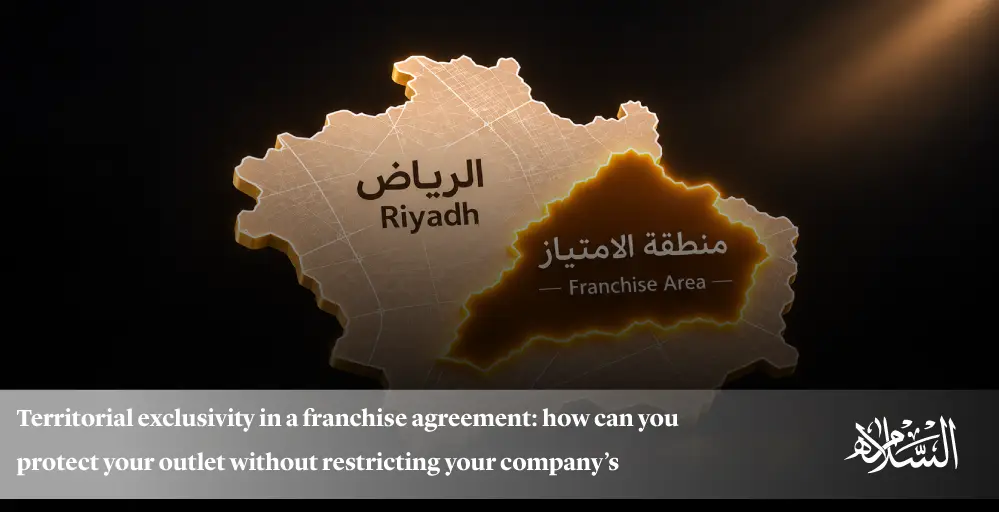
Territorial exclusivity in a franchise agreement: how can you protect your outlet without restricting your company’s expansion?
In one commercial dispute, a franchisor entered into an agreement with a franchisee to operate a business within a defined territory. The agreement identified the franchisee as the party granted franchise rights in that territory. However, the franchisor did not honour the exclusivity arrangement. It distributed its products to more than 18,000 customers across the Kingdom, disregarding the agreed territory. It also sold on its own account and through its personnel to other customers outside the franchise agreement, within the same territories and markets served by franchise customers.
As a result, the franchisee’s sales declined, and the business became commercially unviable. When the dispute reached court, it emerged that the agreement contained no specific clause binding the franchisor to exclusivity; the exclusivity wording referred only to the franchisee. Nevertheless, the court held that reciprocal exclusivity was an inherent obligation of both parties to the franchise and that the franchisor’s breach accounted for the business’s poor performance and reduced sales.
The issue is more than whether an exclusivity clause exists. Territorial exclusivity in franchise agreements is not merely a contractual preference; it is central to the relationship. Without it, the franchise becomes little more than the sale of a name, and the franchisee loses the advantage it paid for. Every decision-maker should ask: does the agreement I signed clearly define territorial exclusivity, or has it left the matter to the court’s interpretation?
Territorial exclusivity: who protects whom?
Exclusivity in a franchise agreement is a reciprocal obligation. The franchisor undertakes not to grant other franchises within the same territory and may also undertake not to sell directly there. The franchisee undertakes not to source from other suppliers or operate outside its territory. This is known as reciprocal exclusivity, which Saudi commercial courts have affirmed on more than one occasion.
Exclusivity is intended to protect both parties. The franchisor protects its brand from fragmentation and ensures that each outlet generates a reasonable return. The franchisee protects its investment and ensures that internal competition does not erode its profits. Without exclusivity, the franchisee may find itself competing with the franchisor itself or another franchisee in the same territory. This can make the business unsustainable.
How can a company define territorial exclusivity?
Defining the territory is a strategic decision, rather than a technical exercise. It must be precise and unambiguous. Saudi commercial law requires the parties to agree on granting franchise rights within a defined area, whether a city, a street, or a particular unit. Both parties should avoid ambiguity and clearly distinguish the territory from other operating areas.
Ambiguity in defining the territory is one of the most frequent causes of disputes. Describing the territory as “the Western Region” or “the city of Riyadh” is not enough. The agreement should identify the districts, streets, or coordinates. If the territory covers more than one outlet, it should specify the permitted number of outlets and the process for opening them.
Another important question is whether exclusivity covers online sales. This issue did not arise in traditional agreements. With the growth of e-commerce, however, territorial exclusivity becomes meaningless if the franchisor sells through its website and ships to the franchisee’s territory. A well-drafted agreement therefore clearly states whether exclusivity covers online sales channels or is limited to physical outlets.
Regulating online sales within the territory
Online selling is more than an additional channel; it is a market in its own right. The agreement must regulate it clearly. May the franchisee sell online? May it ship outside its territory? May the franchisor sell directly online within the franchisee’s territory?
The answers depend on the agreement’s wording. If the agreement is silent, the parties may have to rely on interpretation, which may serve neither party’s interests. The agreement should specify:
- Whether the franchisee’s rights include online sales and, if so, whether it may ship to other territories or only within its own.
- Whether the franchisor may sell directly online and, if so, whether it may ship to the franchisee’s territory or whether direct sales there are prohibited.
- How orders from outside the territory will be handled: will they be referred to the relevant franchisee or handled by the franchisor?
- How commissions on online sales will be calculated, and whether those sales will count towards the franchisee’s sales or constitute separate revenue for the franchisor.
These questions cannot be postponed. E-commerce will not wait. If the agreement does not address these matters, disputes will arise when online sales begin affecting outlet sales.
Regulating the opening of outlets within the territory
Territorial exclusivity does not mean the franchisee may open an unlimited number of outlets within its territory. A well-drafted agreement specifies the number of outlets, the process for opening them, and the opening schedule.
There are several models. Some agreements grant the franchisee the right to develop a specified number of outlets within a defined period. Others grant priority rights to open new outlets, subject to conditions. Others require the franchisor’s approval for each new location because the franchisor wants to ensure that the location is suitable and will not adversely affect other outlets.
The Saudi Franchise Law gives the franchisor the right to monitor the franchisee’s performance and ensure compliance with brand standards. This includes new locations. However, that right must not become a means of restricting the franchisee and preventing expansion without legitimate grounds. A balance is required.
How can you protect your company without restricting its expansion?
Protection begins with the agreement. Do not rely on a general clause stating that “the franchisee has exclusivity.” Define the territory precisely. Specify whether exclusivity covers online sales. Establish the number of outlets and the process for opening them.
The second consideration is balance. Exclusivity is not an absolute right; it is a reciprocal obligation. If the franchisor wants to secure expansion, it should agree on development targets with the franchisee. If the franchisee wants protection from competition by the franchisor, it should agree on clear restrictions on direct sales.
The third consideration is periodic review. Markets change, and sales channels evolve. A territory that was suitable five years ago may no longer be suitable today. Review the agreement periodically and confirm that it continues to protect your interests.
The fourth consideration is legal advice. Franchise agreements are complex, and their details require careful review. The difference between a well-drafted agreement and an ambiguous one may be a dispute a few months later.
Frequently asked questions
Is territorial exclusivity mandatory in franchise agreements?
No. It is not expressly required by law, but it is a central element of most franchise agreements. Where it exists, it is a reciprocal obligation. If it is not clearly defined, it may lead to a dispute.
Does territorial exclusivity cover online sales?
That depends on the agreement’s wording. If the agreement is silent, exclusivity may not cover online sales. The agreement should clearly specify whether exclusivity extends to online sales channels or is limited to physical outlets.
Can the franchisor sell directly within the franchisee’s territory?
If the agreement provides for territorial exclusivity, the franchisor may not sell directly within the franchisee’s territory unless the agreement provides otherwise. The agreement should expressly prohibit or regulate direct sales.
How should the territory be defined in the agreement?
It should be defined precisely by reference to the city, district, street, or coordinates. A general reference to the region’s name is not enough. Ambiguity in defining the territory creates scope for disputes.
What should the franchisee do if the franchisor breaches exclusivity?
The franchisee should document the breach, issue a formal legal notice, and then seek compensation or rescission of the agreement, depending on the contract and applicable law. Advice from a specialist legal adviser is recommended.